Science Spotlight

Subscribe

Receive Science Institute news by email.

    All Science Spotlight Articles

    rss

    a white-spotted fawn lies in straw as its leg is measured
    CDFW Environmental Scientist Brian Ehler measures the hind-foot length on a fawn captured near Medicine Lake for a mule deer study.

    four deer are suspended in the air, in safety harnesses, from a red helicopter
    CDFW Environmental Scientist Brian Ehler measures the hind-foot length on a fawn captured near Medicine Lake for a mule deer study.

    Driving up Interstate 5 through Siskiyou County in northern California, one cannot help but take notice of the looming, majestic land mass of Mount Shasta, the largest volcano in the Cascade system.

    In this rugged region of the Golden State, mule deer are an iconic species, valued by recreationists and required by wild carnivores who prey upon them for nourishment. Mule deer are considered a “foundation species” because the large landscapes that are necessary for their survival can also be home to a vast array of other wildlife and plant species. But mule deer populations have dramatically declined in recent decades across many western ranges, and in Siskiyou County, this decrease has prompted researchers from CDFW and the University of California, Santa Cruz to partner on a multi-year effort to investigate the population dynamics of this high-profile species.

    Since 2015, 51 adult female mule deer and 37 fawns have been captured in the Mount Shasta region. Biological samples, including blood and parasites, have been collected, physical measurements of body condition and age recorded and telemetry collars attached to each subject. Collars on adult deer provide a GPS location every hour and alert researchers when a mortality occurs. The collars also document movement details, including migration routes and the location of critical winter and reproductive ranges. The fawn collars feature location beacons that allow researchers to monitor both general movements and when a mortality has occurred. Once a mortality alert is sent from a collar, a search of the site and an examination of the carcass ensues to determine if the deer died from predation or other causes, such as disease or malnutrition. The collars have timed releases and are set to drop off the animal after 18 months. Researchers can then reuse the collars after retrieving them by following a GPS signal. This high-tech, high-resolution documentation of deer behavior is vital for prioritizing the conservation value of landscapes so they may be better protected in the future.

    With the recent arrival of gray wolves to northeastern California, predators are a key focus of the mule deer project. Understanding the influence this large canid will have on natural prey species begins with establishing baselines of how current predators -- including mountain lions, bears, bobcats and coyotes -- are affecting prey in this region. Mountain lions, which rely on deer as the primary component of their diet, are a major focus of this study. Researchers have captured and affixed five adult mountain lions with GPS telemetry collars, allowing them to track and study rates of predation, feeding patterns and diet composition.

    The analysis of fecal DNA combined with new statistical techniques is another way to study population density and composition across broad landscapes. DNA analysis allows researchers to determine the sex and identity of an individual deer, which is used to estimate densities and gender ratios. Researchers are collecting fecal samples throughout the mule deer’s summer range, in the hopes of reliably extrapolating estimates of density and sex ratios across the entire region.

    This project, which began in 2015, is scheduled to continue into 2019, as researchers strive to gain further insight into the lives of mule deer and predators across this ecologically complex and breathtakingly beautiful region of the state.

    California Department of Fish and Wildlife photos.
    Top photo: Mount Shasta in winter.

    Categories:   Wildlife Research


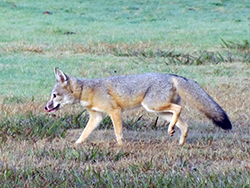
    a healthy San Joaquin kit fox walks on a grassy field
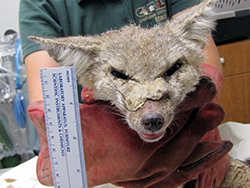
    a San Joaquin kit fox, its face ravaged by mange
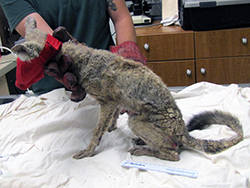
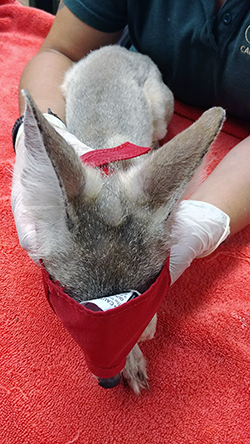
    a kit fox with mange sits on an exam table with a red calming mask on its face
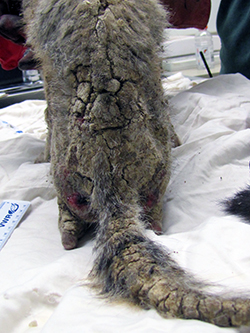
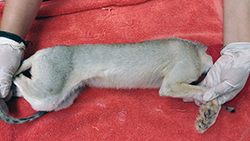
    the mange-ravaged back and tail of a kit fox, with bloodied thighs
    healthy-looking San Joaquin kit fox after treatment for mange
    a kit fox with fur returning to normal after treatment for mange
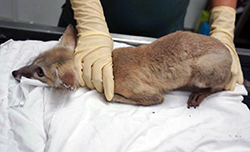
    auburn-furred kit fox, held on an exam table, after mange treatment

    Fate has not been kind to the San Joaquin kit fox (Vulpes macrotis mutica).

    Shrinking habitat caused by urbanization and agricultural expansion landed this Central Valley native on the federal Endangered Species List decades ago. California’s total population of San Joaquin kit foxes may now be down to a few thousand animals. To make matters worse, its favorite food, the kangaroo rat, is likewise endangered as the desert habitat it prefers continues to disappear.

    Wildlife biologists took heart, however, in a population that seemed to be thriving within the city limits of Bakersfield. Unlike San Joaquin kit fox populations in other parts of the Central Valley range, the Bakersfield foxes adapted quite nicely to urban life. Their number – estimated between 200 and 400 animals – has evidently seemed to be holding steady and possibly increasing.

    Their cute and cuddly appearance make them popular with city residents. Earlier research showed the population was healthy and genetically robust. Wildlife biologists were counting on those urban foxes to ensure the species’ survival should kit fox populations completely collapse elsewhere.

    Today, those Bakersfield kit foxes are under siege, suffering from an outbreak of highly infectious sarcoptic mange. Mange – a skin condition caused by parasitic mites -- leads to hair loss, open wounds from scratching and, ultimately, death. The first case was detected among the kit fox population in March 2013, and since then, more than 200 cases have been documented. The epidemic has grown worse every year.

    Given the importance of the Bakersfield population, CDFW, the U.S. Fish and Wildlife Service, the California State University, Stanislaus, the University of California, Davis (UCD), and various nonprofit wildlife groups have all joined forces to combat the mange.

    Jaime Rudd, an environmental scientist in CDFW’s Wildlife Investigations Lab in Sacramento, is leading CDFW’s efforts while simultaneously writing her UCD Ph.D. dissertation on the outbreak. Rudd is researching ways to prevent mange from spreading to healthy animals, and assisting Stanislaus State’s Endangered Species Recovery Program with trapping and treating diseased foxes.

    Severely diseased kit foxes are trapped and transported to the California Living Museum, a Bakersfield wildlife rehabilitation facility and zoo. There, the kit foxes are hospitalized, given life-saving antibiotics and fluids and treated with a topical pet product that kills the mites. The foxes often need months of treatment before they are healthy enough to release. And although the intervention saves individual lives, the process is costly and time-consuming – and doesn’t prevent the treated fox from getting mange a second or third time.

    Rudd is making good use of her undergraduate degree in molecular biology, analyzing the DNA of the mites to see if they might be related to those in dogs and coyotes, which could be spreading the mange to the foxes.

    “Essentially, we want to look at their molecular signature to see if these mites are related,” Rudd said.

    Rudd is studying a group of wild kit foxes living on the CSU Bakersfield campus, which no doubt are supplementing their diet with burger bits and pizza crusts discarded by college students. Rudd is monitoring the group with trail cameras, outfitting some foxes with radio tracking collars and others with the type of preventative flea and tick collar you might use on a pet dog or cat.

    “We want to evaluate the efficacy of these collars,” she said. “If they’re only going to work for two months, the collars won’t help us slow down the spread of mange, so is it really worth the effort of putting them on? But if they’re going to work for five months or more, then it might be worth the effort.”

    If there is any hope sustaining Rudd and her colleagues in this important, though often disheartening, work, it’s this: “The fact we are not seeing mange in the outlying populations is cause for optimism,” she said. “If nothing else, we can at least try to keep it from leaving the city.”


    The top photo is a female San Joaquin kit fox with sarcoptic mange. The next six photos show a progression of mange in one of Jaime Rudd’s Bakersfield study animals, a male kit fox. The photos show a healthy animal in January 2017 before getting mange. The next three shots show him infected with mange in July 2017. The next two are four weeks after treatment for mange in August 2017. CDFW photos by Jaime Rudd.

    The last photo is another kit fox, six weeks after treatment. Photo by Erica Kelly, Endangered Species Recovery Program (ESRP), a multi-agency/university program at CSU Stanislaus.

    To see CDFW Scientific Aide Megan O’Connor release a treated San Joaquin kit fox back to the CSU Bakersfield campus, click here.


    Categories:   Wildlife Research

    live abalone in the ocean, covered with marine organisms
    three men and one woman on aft deck of small research vessel

    California’s coastal waters are home to seven species of abalone, and all but one are endangered or listed as species of special concern. The white abalone in particular has been nearly decimated by overfishing and disease, and scientists can find no evidence that the remaining population is reproducing in the wild. In order to avoid loss of the entire species, CDFW and partner agencies have formed the White Abalone Recovery Consortium, which will employ captive rearing and restoration stocking efforts and extensive public outreach in order to save these animals from extinction. It will be an ongoing, long-term project, but all signs point to future success – already there are more white abalone thriving in the captive breeding program than the entire population living in the wild.

    Read more about the efforts to restore California’s white abalone – and learn what you can do to help! – on the CDFW Marine Management News Blog.

    Categories:   Wildlife Research

    The latest issue of California Fish and Game, CDFW’s scientific journal, is now available online. This century-old quarterly journal contains peer-reviewed scientific literature that explores and advances the conservation and understanding of California’s flora and fauna.

    The endangered salt marsh harvest mouse (Reithrodontomys raviventris) graces the cover of California Fish and Game, Volume 103, Issue I. Researchers ventured into the pickleweed to study the tiny mouse, which is endemic to the marshes surrounding the San Francisco Estuary Bay and its tributaries. The mice were fitted with tiny radiotelemetry collars and tracked for three years. Researchers documented some curious behavior in the resulting paper, “Potential evidence of communal nesting, mate guarding, or biparental care.” The accompanying photos provide a fascinating glimpse into an active nest.

    Another paper, “Documentation of mountain lion occurrence and reproduction in the Sacramento Valley of California,” explores the potential for mountain lions to exist in fragmented habitats if there is adequate connectivity with larger blocks of suitable habitat and sufficient prey. The study used camera traps to document populations of mountain lions in the Sacramento Valley’s Butte Sink, which is made up of relic riparian habitats interspersed with managed wetlands. The photos show healthy mountain lions moving through habitat that has long been considered unsuitable due to extensive agricultural and urban development.

    The article, “Mussels of the Upper Klamath River, Oregon and California,” reports on sampling efforts that expand existing baseline population data on freshwater mussels in the Upper Klamath River. The sampling efforts may ultimately assist with protection, mitigation and enhancement efforts for large bi-valve species.

    The final paper provides insights into the benefits deer and elk derive from licking mineral rocks. Researchers took samples of “lick sites” that were used by California black-tail deer (Odocoileus hemionus columbianus) and Roosevelt elk (Cervus canadensis roosevelti) in the Klamath Mountains, Siskiyou County. After performing a detailed analysis of the elemental content of each lick site, the researchers concluded that each lick site offers a different smorgasbord of minerals, and in varying concentrations. The study’s objective is to begin identifying, classifying, and analyzing important mineral lick sites to benefit future ungulate management efforts.

    As it has for the past 103 years, California Fish and Game continues to publish high-quality, peer-reviewed science that contributes to the understanding and conservation of California’s wildlife. We look forward to witnessing the contributions of the next installment.

    Download the link opens in new windowentire Winter Issue 103 (PDF) in high resolution, or browse individual articles in low resolution.

    Categories:   California Fish and Game Journal, Wildlife Research

    sunrise over a California salt marsh
    two young women in a marsh, one holds a tiny mouse

    Deep in the pickleweed in the San Francisco, San Pablo and Suisun Bays, the tiny salt marsh harvest mouse (Reithrodontomys raviventris) tries to avoid predators and compete with other species for prime habitat. Food and cover are abundant, but its overall habitat is shrinking as humans encroach upon its home range. In south San Francisco Bay alone, 95 percent of the historic salt marsh has been lost to industrial parks and subdivisions. Annual flooding in the winter can be perilous, too -- when vegetation is topped by rising tides, the mice must scramble to find taller vegetation or into upland habitat (grasses around the wetlands that don’t get flooded by the tides).

    As part of the effort to monitor and conserve this state- and federally-listed endangered species, biologists conduct annual surveys of the salt marsh harvest mouse. The effort involves setting up traps stuffed with cotton batting and baited with birdseed and walnuts, taking measurements and collecting other data on the subjects that are captured. In some studies, the mice are fitted with GPS collars for tracking, or ear tags to help identify them upon recapture. In other studies, the biologists simply clip away fur on the mouse’s flank or neck – another method that helps them determine whether a mouse in a trap has crossed paths with them before.

    Once a mouse’s measurements have been recorded, they are set loose to scamper back into the pickleweed. The data that’s been collected will later be entered into a larger database that will be accessible to researchers from multiple state agencies (CDFW, the Department of Water Resources), federal agencies (US Fish and Wildlife Service, the US Geological Survey), educational research institutions (UC Davis, CSU San Marcos, San Francisco State) and private industry.

    By comparing population fluctuations and other data throughout the range, scientists hope to identify threats and increase their understanding of this rare rodent’s biology and behavior – ultimately helping to better inform future decisions on habitat management, restoration and enhancement efforts.

    Categories:   Wildlife Research