CNDDB logo

Subscribe

Sign up to receive new posts by email.

    Search

    CNDDB News Blog

    All CNDDB Blog Posts

    rss
    Photo mosaic of different California ecosystems with the California Biodiversity Data Exchange logo layered over the top. From left to right, the ecosystems pictured are an ocean bluff, grassland near an urban area, California poppies, redwood forest, and a Joshua tree.

    Photo credit: California Academy of Sciences

    It is now easier than ever for the California Natural Diversity Database (CNDDB) to incorporate your iNaturalist records for sensitive plant and wildlife taxa, thanks to the California Biodiversity Data Exchange (CalBioDEx, for short). This is a first-of-its-kind partnership between the CDFW, the California Academy of Sciences, and iNaturalist in order to facilitate data sharing of iNaturalist records for sensitive species with CDFW for species conservation and management decisions.

    The CNDDB has long maintained an iNaturalist project to reach out to individuals about their sensitive species observations, which currently has 150,000+ observations of over 2,400 sensitive species. Observations that you opt to share with CDFW through the CNDDB project will continue to be a valuable resource, especially when users fill out the suggested observation fields (number observed, reproductive evidence, etc.).

    A more streamlined data flow between iNaturalist and CDFW will make it easier for CNDDB staff to process that data into Element Occurrences (EOs), which are broadly used for environmental review and conservation purposes, as well as to inform state and global conservation status ranks. We expect it will take several years for iNaturalist observation data to be fully integrated into the CNDDB system. Submitting data to iNaturalist will not satisfy project or permit requirements to submit data to CNDDB; direct submissions to CNDDB will continue to be important.

     As part of the data exchange, we are also working with our partners at the Academy and iNaturalist to identify data gaps for sensitive species and leverage targeted citizen science campaigns to fill in those gaps. As part of this collaboration, CalBioDEx has developed an outreach campaign focusing on increasing the number of high-quality iNaturalist observations of clovers (Trifolium spp.) and milkvetches (Astragalus spp.). You can start Counting Clover and Mapping Milkvetch (PDF) right now by joining the project and keeping an eye out for these often-overlooked plants. The event runs from March through August, and we’ll be highlighting some of the neat CNDDB-tracked clovers and milkvetches you may encounter in future updates!

    Categories:   Education and Awareness, Partner Spotlight

    The Biogeographic Data Branch continually works to improve our data and tools for everyone. We announced back in June that BIOS 6 has launched. Though BIOS 6 is similar to BIOS 5, there are some differences that may hang up even our most experienced users. Therefore, we want to bring your attention to several training videos and user guides that are available on our training page that may assist you in using this new tool.

    • Training videos
      • BIOS 6 Basics, BIOS 6 Tools, BIOS Advanced Tools – A series of videos that cover the background, purpose, structure, and tools in BIOS, ranging from the basic functions to the most advanced tools.
      • Accessing CNDDB and Spotted Owl Data using BIOS and RareFind – A video that demonstrates various ways our users can use BIOS and RareFind to dig deeper into the data within the CNDDB and Spotted Owl Observation Database.
    • User guides
      • BIOS 6 Getting Started – A condensed version of basic BIOS 6 functions
      • BIOS 6 Data Viewer User Guide – Full user guide of BIOS 6 functions
      • Using the CNDDB Data in BIOS 6 – A guide to a subset of BIOS 6 tools that a CNDDB user may typically use.
      • CNDDB QuickView Tool User Guide for BIOS 6 – A guide to using the QuickView Tool in BIOS 6
      • Using the Spotted Owl Reports Tool in BIOS 6 – Instructions for generating Spotted Owl reports in BIOS 6

    Please note that BIOS 5 will no longer be available starting January 2023 as we fully transition to BIOS 6. Please share with others that may need to know this information. If you have questions about BIOS 6, you can submit them to BIOS@wildlife.ca.gov.

    Categories:   Education and Awareness

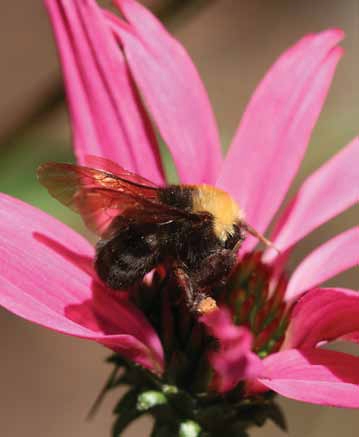
    Franklin's bumble bee on a flower with long, pink petals
    Bombus franklini
    photograph by James P. Strange, USDA-ARS Pollinating Insect Research Unit, Public domain, via Wikimedia Commons

    A year ago in October of 2021, we posted about the legal status of bumble bees in California. Four of these bumble bees (B. franklini, B. crotchii, B. occidentalis, B. suckleyi) were petitioned for listing as endangered species under the California Endangered Species Act (CESA) in 2018. The California Fish and Game Commission determined that listing all four species as endangered “may be warranted” in June 2019, and the species advanced to candidacy. The Commission’s determination was challenged in court soon after, and candidacy or related protections were stayed during much of the ensuing litigation. A California court of appeal ultimately upheld the Commission’s determination, and the state Supreme Court declined to review the case. Candidacy was reinstated for all four bumble bee species on September 30, 2022. As candidate species, they receive the same legal protection afforded to endangered or threatened species (Fish & G. Code, §§ 2074.2 & 2085).

    Both the Suckley’s and western bumble bees have been petitioned for federal listing and received positive 90-day findings. The species status assessment for western bumble bee is scheduled to be released in fiscal year 2024, and Suckley’s in fiscal year 2025.

    The California Natural Diversity Database (CNDDB) tracks an additional two species of bumble bee considered species of greatest conservation need. This table includes the current status of all bumble bees tracked by the CNDDB:

    Common Name Scientific Name State
    Status
    Federal
    Status
    NatureServe
    State Rank
    Other Status
    Franklin's bumble bee B. franklini Candidate Endangered S1 IUCN Critical
    Crotch bumble bee B. crotchii Candidate None S1S2 IUCN Endangered
    western bumble bee B. occidentalis Candidate None S1 IUCN Vulnerable
    Suckley's cuckoo
    bumble bee
    B. suckleyi Candidate None S1 IUCN Critical
    obscure bumble bee B. caliginosus None None S1S2 IUCN Vulnerable
    Morrison bumble bee B. morrisoni None None S1S2 IUCN Vulnerable

    Categories:   Education and Awareness

    Biogeographic Data Branch
    Physical Address: 1700 9th Street, 4th Floor, Sacramento, CA 95811
    Mailing Address: P.O. Box 944209, Sacramento, CA 94244-2090
    (916) 322-2493 | BDB@wildlife.ca.gov