Science Spotlight

Subscribe

Receive Science Institute news by email.

    All Science Spotlight Articles

    rss
    Juvenile Chinook salmon.

    The Klamath River is back in the news as juvenile salmon are turning up dead, and there are questions about parasites. Here’s what’s happening.

    CDFW is working closely with our scientific colleagues at the U.S. Fish and Wildlife Service, Cal Poly Humboldt and Oregon State University to monitor Klamath River salmon and the impacts of the naturally occurring, microscopic C. Shasta parasite (short for Ceratonova shasta). This parasite is common in the Klamath and other Pacific Northwest rivers and its impact ebbs and flows with environmental conditions. Hot weather, warm water and low flows – conditions the Klamath is currently experiencing – can increase its prevalence.

    On the evening of May 14, CDFW’s Fall Creek Fish Hatchery released 675,000 certified pathogen-free Chinook salmon smolts into the Fall Creek tributary of the Klamath River about 7 miles upstream of the former Iron Gate Dam location.

    The release was also timed when C. Shasta levels in the river had decreased and ahead of forecasted storms, which would improve water quality and accelerate the smolts’ outmigration to the Pacific Ocean. Since then, C. Shasta levels have increased and some of these hatchery fish have been found dead in monitoring traps upstream of the Interstate 5 bridge near the former Iron Gate Dam location. Lab results have confirmed the presence of C. Shasta and another parasite, Parvicapsula minbicornis, in these dead fish. CDFW continues to track the movement of hatchery fish and remains confident that a proportion of Fall Creek Fish Hatchery-origin salmon escaped the impacts of C. Shasta and other parasites.

    Additionally, CDFW tributary monitoring of wild juvenile salmon populations indicates the majority of wild fish had already outmigrated ahead of elevated levels of C. Shasta. The C. Shasta parasite does not impact ocean salmon or ocean salmon fishing.
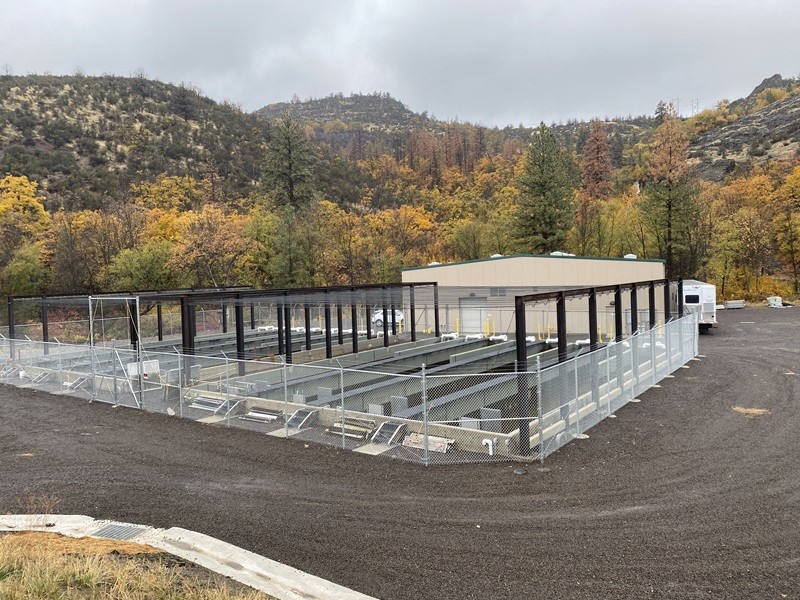
    CDFW's Fall Creek Fish Hatchery

    It’s important to understand that some mortality due to pathogens is expected and is a natural part of the salmon life cycle. A pair of Chinook salmon will typically produce around 4,000 offspring but even under ideal conditions, more than 99 percent of those offspring will succumb to pathogens or predation prior to reaching adulthood. While the C. Shasta levels in the Klamath are elevated and somewhat concerning, early spring C.Shasta levels were lower than levels seen in previous drought years prior to Klamath dam removal, and C.Shasta related mortalities in the spring of 2024 and 2025 following dam removal were significantly lower, which are encouraging signs for the future.

    CDFW will continue to monitor and track basin-wide conditions through the Klamath Fish Health Assessment Team as adult salmon return to the Klamath River over the summer.

    ###

    Media Contact:
    Peter Tira, CDFW Communications, (916) 215-3858

    Categories:   Science Spotlight

    map of Battle Creek watershed area

    Habitat is the key to the long-term survival of Sacramento River winter-run Chinook in California. Since 1999, CDFW has been working with multiple agencies and private parties on planning efforts to restore the population of these endangered salmon. More than $100 million has been allocated to specific habitat restoration work on Battle Creek, which comprises approximately 48 miles of prime salmon and steelhead habitat.

    Over the next two months, link opens in new windowapproximately 200,000 juvenile winter-run Chinook will be released into the North Fork of Battle Creek. The introduction of these fish, which were spawned from adults last summer, is occurring sooner than expected due the availability of fish from the Livingston Stone National Fish Hatchery Winter-run Chinook Captive Broodstock Program. The fish were raised at Coleman National Fish Hatchery and are being released by Coleman Hatchery personnel. These additional fish could help bolster the winter-run Chinook population and be a potential catalyst in their recovery.

    CDFW Senior Environmental Scientist Doug Killam has worked on the Battle Creek Reintroduction Plan for nearly a decade and has been instrumental in moving in-stream projects forward. Killam sees the release of 200,000 smolts as an important step in the overall effort. The release will reestablish winter-run Chinook in a new drainage and create a separate new population. Currently there is only one viable population existing in the Sacramento River directly below Keswick and Shasta Dams. The recent drought affected the volume of the critical cold-water pool in Shasta Lake and the release of warmer water in the drought years of 2014 and 2015 resulted in major losses to eggs and young salmon below the dam. Biologists have long recognized that having more than one winter-run Chinook population is imperative for the long-term survival of the species.

    A volcanic region with rugged canyons and dramatic scenery, the North Fork of Battle Creek is unique since it has both cold snowmelt water and large amounts of spring water flowing into it at critical times for winter-run salmon to hold over in and spawn in. It is also one of a handful of waters that can support all four of the Chinook salmon runs that return to the Sacramento River Basin. Hydroelectric development of the creek in the early 1900s largely eliminated winter-run Chinook and other salmonid runs from swimming far upstream to access the cooler water required for these unique summer spawning salmon. Recent efforts to bring the fish back to the North Fork include dam removals, rock fall removal, new fish ladders and fish screens and – most importantly – an agreement to increase stream flows to provide fish with the water quantity and quality they need to survive and thrive in this important keystone stream.

    CDFW photo by Heather McIntire. Map by CDFW Fisheries Branch.

    Categories:   General