Science Spotlight

Subscribe

Receive Science Institute news by email.

    All Science Spotlight Articles

    rss

    CDFW Biologists and Scientific Aids conducting electrofishing operations to briefly stun fish so they can be identified, measured, tagged or sampled before being released unharmed.
    CDFW Biologists and Scientific Aids conducting electrofishing operations to briefly stun fish so they can be identified, measured, tagged or sampled before being released unharmed.

    Steelhead are among California's most remarkable fish. Born in freshwater streams, these ocean-going rainbow trout can migrate hundreds of miles to the Pacific Ocean before returning to the very streams where they hatched to spawn. Understanding where steelhead live, how they use habitat, and how many adults return each year is critical to conserving these iconic fish.

    “The best way to understand and support this unique species is to monitor steelhead throughout the year using a variety of scientific techniques tailored to each season,” according to Deena Hansen, the California Department of Fish and Wildlife (CDFW) senior environmental scientist supervisor who oversees steelhead monitoring across the South Coast Region for the Department in southern California.
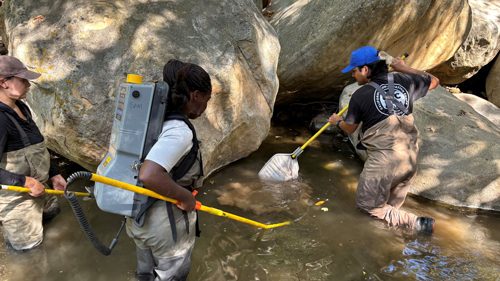
    CDFW Biologists and Scientific Aids conducting electrofishing operations to briefly stun fish so they can be identified, measured, tagged or sampled before being released unharmed.
    CDFW Biologists and Scientific Aids conducting electrofishing operations to briefly stun fish so they can be identified, measured, tagged or sampled before being released unharmed.

    Summer through Mid-Fall: Surveying Young Fish

    As weather conditions dry out and stream flows recede during the summer and fall, biologists conduct electrofishing and snorkel surveys to assess juvenile steelhead and resident rainbow trout populations. Occasionally, adult steelhead may spend their summers in freshwater, though it is less common.

    Electrofishing uses a battery-powered backpack to send a controlled electric shock into the water. The electric current temporarily stuns fish, allowing scientists to net them and transfer them to buckets. Biologists then identify species, measure individuals, evaluate their health, and document where they occur before quickly returning them to the water. In areas where water clarity and habitat conditions allow, snorkel surveys provide another effective way to observe fish in their natural environment with minimal disturbance.

    These surveys help scientists understand where steelhead are thriving, how they use available habitat, and how environmental conditions influence survival.

    Late Fall through Early Summer: Tracking the Return Home

    When rain arrives and river levels begin to rise in the fall and winter months, adult steelhead begin their migration back to freshwater to spawn.

    During this critical period, CDFW biologists conduct redd surveys, searching streams for the gravel nests, known as redds, that female steelhead construct to lay their eggs. Steelhead and rainbow trout are the same species, but while steelhead migrate from freshwater to the ocean, rainbow trout spend their entire lives in freshwater. Counting redds helps estimate spawning activity and identify important spawning habitat. Steelhead redds stand out from resident rainbow trout redds because they are typically larger, reflecting the larger size of the adult steelhead.

    In some watersheds, sonar cameras complement traditional field surveys by allowing scientists to monitor fish migrations without handling the fish. “Sonar cameras are like a fish finder, except they look across a river from bank to bank instead of down to the bottom," according to Hansen. The equipment is especially valuable in high-flowing or turbid, sediment-rich watersheds where other sampling methods may not be effective, and because it operates around the clock, it allows biologists to continuously monitor fish movement. These systems provide valuable information on the timing and number of returning adults while minimizing disturbance during spawning season.
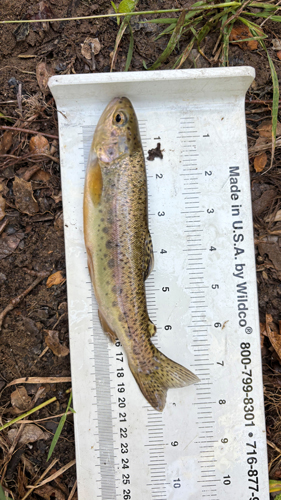
    Steelhead being measured by CDFW biologists before being released.
    Steelhead being measured by CDFW biologists before being released.

    Young steelhead develop into smolts and after spending 1 to 3 years in freshwater, they begin their migration to the ocean. This typically occurs from late winter through early summer when higher flows trigger outmigration. CDFW biologists use a variety of monitoring techniques to better understand their survival and movement. In addition to tracking juvenile steelhead as they migrate to the ocean, CDFW biologists use a variety of monitoring techniques to monitor or capture fish in different watersheds, including:

    • Acoustic telemetry: Small transmitters are attached to fish, allowing scientists to track their movements and survival as they travel through rivers and estuaries.
    • Passive Integrated Transponder (PIT) tag arrays: Tiny electronic tags implanted in fish are detected by stationary antennas, helping biologists monitor migration timing and movement without recapturing the fish.
    • Rotary screw traps: Cone-shaped traps placed in rivers safely capture downstream-moving juvenile fish so biologists can estimate abundance, migration timing and overall population trends before releasing them.
    • Seine nets: Large nets are pulled through shallow water to temporarily capture fish, allowing scientists to assess species’ composition, abundance and size before releasing them.
    • Fyke nets: Funnel-shaped nets that passively capture fish moving with the current, providing information on migration patterns and fish abundance.
    • Electrofishing: A carefully controlled electrical current is used to briefly stun fish so they can be identified, measured, tagged or sampled before being released unharmed.

    Together, these tools help scientists track steelhead as they make the critical transition from freshwater to the ocean and back, providing valuable information to guide conservation and fisheries management.

    Science Across Every Season

    No single survey tells the whole story. By monitoring steelhead life stages throughout the year, CDFW scientists build a more complete picture of population health, habitat use, and reproductive success.

    “The information collected helps guide our habitat restoration efforts, informs our fisheries management decisions, and supports conservation efforts aimed at maintaining healthy, resilient steelhead populations across California,” said Audrey Dean, one of CDFW Fisheries Branch’s senior environmental scientists that coordinates the statewide California Monitoring Program.

    Every season offers another opportunity to learn about these remarkable fish. Together, year-round monitoring helps ensure that future generations can continue to witness one of California's most extraordinary wildlife migrations.

    ###

    Media Contact:
    Cort Klopping, CDFW Communications, (916) 201-2958

    Categories:   Science Spotlight, steelhead, Wildlife Research

    Image of a healthy steelhead trout being measured and surveyed in 2017.
    A healthy steelhead trout surveyed at Pescadero Creek Lagoon Complex in 2017

    Dozens of dead steelhead trout are pictured following a turbulent wintertime breach of the lagoon in 2014.
    The aftermath of a winter sandbar breach 2014. These nearly annual breaches resulted in large die-offs for the lagoon’s steelhead.

    Wide shot of a manual sandbar breach between the lagoon and ocean. Scientists manually breach the lagoon to prevent fish deaths caused by the nearly annual wintertime sandbar breaches.
    A manual breach of Pescadero Creek Lagoon Complex. Managed breaches of the lagoon can prevent fish kills caused by turbulent natural breaches. Photo Courtesy of UC Davis School of Veterinary Medicine

    There’s a dichotomy in the way Pescadero Creek Lagoon Complex in coastal San Mateo County has both supported—and been detrimental to—steelhead trout for much of the past 25 years.

    On one hand, the lagoon complex—the largest tidal marsh between Elkhorn Slough and the San Francisco Bay estuary—boasts high growth rates for Central California Coast Steelhead. The lagoon system allows the species, which is federally listed as endangered, to reach a size that increases their likelihood of surviving at sea. Steelhead also use the system for juvenile rearing and resting during migration.

    On the other hand, nearly every year since the mid-1990s, the lagoon faced harsh fall/winter sandbar breaches that filled the system with oxygen-depleted water and spread toxic sediment produced by the breakdown of organic matter like plant material in the absence of oxygen.

    These breaches often resulted in large die-offs for the lagoon’s steelhead population. Historically, population estimates have reached as many as 17,000 steelhead rearing into the fall.

    “It was a one-two punch where fish faced lack of oxygen and got hit with harsh toxic compounds. It was really unfortunate because the lagoon system works so well to grow steelhead, but we were losing the production every year,” said District Fisheries Biologist Jon Jankovitz.

    Efforts to actively manage breaches began in 2012, but were stalled in 2014 and 2015 when the steelhead population was diminished due to drought conditions. In 2015, the California Department of Fish and Wildlife (CDFW) and the National Oceanic Atmospheric Administration (NOAA) partnered with the Department of Parks and Recreation (DPR), which owns much of the land associated with the complex, in adopting a monitoring and management plan.

    In 2016, a significant fish kill caused by a turbulent sandbar breach prompted further action. CDFW, NOAA and DPR resumed active management to improve water conditions and prevent the deadly breaches.

    The restoration team installed a sandbar dam at a major channel to slow the release of oxygen-depleted water and sediment into the system. Staff also preemptively manually breached the lagoon mouth on occasions when they anticipated a harmful natural breach.

    Jankovitz conducts weekly water quality monitoring and twice-monthly dry-season fish sampling to inform management decisions. He produces an annual report on the health of the steelhead population and a summary of seasonal water quality transitions.

    So how has active management faired? There hasn’t been a significant fish kill since 2016.

    “We’ve saved the steelhead population for the last couple of years. We’re fortunate for the success we’ve had so far,” said Jankovitz.

    Another mark of success has been the documented presence this year of sexually mature holdovers, meaning steelhead that were reared in the lagoon for two seasons even though they were large enough to smolt (i.e. migrate to sea).

    “This obviously couldn’t happen if there was a fish kill the year prior. These holdovers represent a life history strategy that may fill in gaps during down reproductive years or periods of poor ocean conditions,” said Jankovitz.

    There’s a long-term restoration plan in the works which would likely involve structural changes, such as relocating culverts and breaching levees, to alter the dynamics of how much tide flows in and out of the system. The plan includes a sediment removal project that was implemented in 2019 to increase fish passage.

    Ultimately, CDFW and DPR would like to keep the system thriving without active management. “We don’t love breaching the lagoon manually because it can be stressful for fish and other aquatic species,” Jankovitz said.

    Meanwhile, fostering an environment in Pescadero Creek Lagoon Complex that supports a large population of fast-growing steelhead continues to be top priority.

    “Aside from being a native California species with a long history of recreational and angler use, steelhead are a great biological indicator of the health of streams and lagoon systems. The ecology of these systems would likely fall apart without them,” Jankovitz said.

    Photos courtesy of CDFW District Fisheries Biologist Jon Jankovitz and the Bodega Marine Lab at University of California, Davis. Top Photo: District Fisheries Biologist Jon Jankovitz with a healthy Pescadero juvenile steelhead.

    Media Contact:
    Ken Paglia, CDFW Communications, (916) 322-8958

    Categories:   General

    A brownish-green river with a glassy surface flows through semi-arid land as two men fish from the rocky shore
    Surveying Ventura River in Ventura County

    A person in a black, full-body wetsuit floats, face-down, in a clear, shallow stream lined by forest and riparian vegetation
    Snorkel survey in Hollow Tree Creek in Mendocino County

    A young steelhead trout is barely visible, camouflaged against greenish-golden rocks in a stream
    Hollow Tree Creek steelhead

    Taking care of California’s fish and wildlife wouldn’t be possible without managing the resources upon which they depend. To that end, CDFW has an entire branch – and many scientific staff – dedicated to the scientific study, and planning and management of water resources.

    Within the Water Branch, CDFW’s Instream Flow Program (IFP) is tasked with collecting and contributing data necessary to make all kinds of important management decisions about ecological function, fish rearing, spawning and migration and habitat suitability.

    In the simplest terms, “instream flow” refers to the rate of the water running through a waterway in a natural environment. But when one considers all the interests competing for use of that water – fisherman, boaters, farmers, businesses, water districts, and fish and wildlife themselves – the complexity of the subject is evident.

    Measured in cubic feet per second (cfs), instream flow can be measured at different times of the year in a specific location in a waterway. The fluctuations can tell scientists quite a bit about the ecosystem health of a watershed. While some watersheds have flowing water throughout the year and others are intermittent it is often the responsibility of water managers to distribute the water between uses. CDFW, a natural resource management agency, is faced with the complex task of identifying and recommending instream flows necessary for supporting natural resources. Determining instream flows are crucial so that aquatic, riparian, and terrestrial resources dependent on water will be considered and protected during water distribution activities.

    Guided by the California Water Action Plan, the Public Resources Code and the Fish and Game Code, IFP staff conduct flow studies, collect field data, develop guidelines for quality assurance, conduct outreach and coordinate with other agencies and interested parties on program-related activities.

    In the past year, some of IFP staff’s largest projects have included:

    • A flow study at the South Fork of the Eel Watershed, which supports threatened coho, Chinook and steelhead.
    • A study of 46 coastal steelhead streams (Ventura County to Siskiyou County) to develop flow criteria and evaluate historic flow trends.
    • A flow study to identify flow regimes that will protect endangered Southern California steelhead in the Ventura River.
    • Technical studies and final flow recommendations based upon the needs of South-Central Coast steelhead in Monterey County’s Big Sur River.
    • Ongoing training for IFP staff, to ensure that field studies in swift water are carried out safely.

    To learn more about these specific projects, please download the link opens in new windowIFP’s 2017 Year in Review (PDF) document, available on CDFW’s website.

    A Featured Scientist Q&A with the IFP manager Robert Holmes is also available on the CDFW Science Institute page.

    CDFW photos. Top photo: IFP staff hold a planning meeting prior to a survey on the Ventura River in Ventura County

    Categories:   General

    map of Battle Creek watershed area

    Habitat is the key to the long-term survival of Sacramento River winter-run Chinook in California. Since 1999, CDFW has been working with multiple agencies and private parties on planning efforts to restore the population of these endangered salmon. More than $100 million has been allocated to specific habitat restoration work on Battle Creek, which comprises approximately 48 miles of prime salmon and steelhead habitat.

    Over the next two months, link opens in new windowapproximately 200,000 juvenile winter-run Chinook will be released into the North Fork of Battle Creek. The introduction of these fish, which were spawned from adults last summer, is occurring sooner than expected due the availability of fish from the Livingston Stone National Fish Hatchery Winter-run Chinook Captive Broodstock Program. The fish were raised at Coleman National Fish Hatchery and are being released by Coleman Hatchery personnel. These additional fish could help bolster the winter-run Chinook population and be a potential catalyst in their recovery.

    CDFW Senior Environmental Scientist Doug Killam has worked on the Battle Creek Reintroduction Plan for nearly a decade and has been instrumental in moving in-stream projects forward. Killam sees the release of 200,000 smolts as an important step in the overall effort. The release will reestablish winter-run Chinook in a new drainage and create a separate new population. Currently there is only one viable population existing in the Sacramento River directly below Keswick and Shasta Dams. The recent drought affected the volume of the critical cold-water pool in Shasta Lake and the release of warmer water in the drought years of 2014 and 2015 resulted in major losses to eggs and young salmon below the dam. Biologists have long recognized that having more than one winter-run Chinook population is imperative for the long-term survival of the species.

    A volcanic region with rugged canyons and dramatic scenery, the North Fork of Battle Creek is unique since it has both cold snowmelt water and large amounts of spring water flowing into it at critical times for winter-run salmon to hold over in and spawn in. It is also one of a handful of waters that can support all four of the Chinook salmon runs that return to the Sacramento River Basin. Hydroelectric development of the creek in the early 1900s largely eliminated winter-run Chinook and other salmonid runs from swimming far upstream to access the cooler water required for these unique summer spawning salmon. Recent efforts to bring the fish back to the North Fork include dam removals, rock fall removal, new fish ladders and fish screens and – most importantly – an agreement to increase stream flows to provide fish with the water quantity and quality they need to survive and thrive in this important keystone stream.

    CDFW photo by Heather McIntire. Map by CDFW Fisheries Branch.

    Categories:   General