Science Spotlight

Subscribe

Receive Science Institute news by email.

    All Science Spotlight Articles

    rss

    California Fish and Game, Volume 104, Issue 2, is now available online! California Fish and Game is CDFW's official, quarterly, scientific journal devoted to the conservation and understanding of the flora and fauna of California and surrounding areas, and the eastern Pacific Ocean.

    A mallard in flight appears on the cover of the newest installment of the journal. With its iridescent green head and school bus yellow legs, the male mallard is one of the most recognizable species of duck in California. It is also the most abundant breeding species of waterfowl in the state. However, California’s mallard population estimates have generally declined since the mid-1990s. In California mallards: a review, Feldheim et. al synthesizes volumes of research in an effort to identify long-term research needs and monitoring activities to help improve management of this iconic species.

    In another paper, entitled Abundance, habitat and occupancy of Roosevelt Elk in the Bald Hills of Redwood National Park, Tolliver and Weckerly seek to understand the relationship between a species’ occupancy-abundance rate and its habitat use. Using elk sign surveys (i.e, counting tracks and feces at standardized locations) researchers found that, as population density increases, Roosevelt elk will move into other (lower quality) habitats. This was true for two herds of vastly different sizes, although the occupancy rate remained comparable.

    Finally, Hiney et. al looks at recruiting experienced anglers and using citizen science to help document and survey the native Coastal Rainbow Trout population of Grass Valley Creek Reservoir. The authors look at methods of overcoming the time and resource limitations of assessing wild trout populations.

    Also included in this issue are reviews of two books that make meaningful contributions to the field of wildlife research.

    As it has for the past 104 years, California Fish and Game continues to publish high-quality, peer-reviewed science that contributes to the understanding and conservation of California’s wildlife. We look forward to witnessing the contributions of the next installment.

    Categories:   California Fish and Game Journal

    The latest issue of the scientific journal California Fish and Game is now available online (for free!). Volume 104, Number 1 features a gorgeous photo of a black-tailed jackrabbit in sunlit profile taken by renowned photographer David Jesse McChesney. The back cover image, also by McChesney, features two cottontails at play. We are fortunate to be allowed the use of these amazing images to promote the content of the latest issue. Individual papers in this issue include:

    • link opens in new windowReproductive aspects of Sphyraena ensis (Perciformes: Sphyraenidae) inhabiting the coast of San Blas Nayarit, southeast Gulf of California (PDF). The Mexican barracuda is the subject of a study that gathers baseline data for this important fishery resource. Although the species constitutes one of the main economic pursuits along the coast of Nayari, Mexico, little is known about its reproductive biology. A one-year study of specimens caught via commercial fishing revealed that females outnumber males (1:1.87 male:female). They also grow larger—a reproductive strategy that allows them to produce more eggs. By comparing the size of the liver and reproductive organs of the specimens, relative to their overall size, researchers were able to determine that both sexes are at their reproductive peak from April to June. The study results suggest that a fishery closure during this peak reproductive time can provide long-term population benefits for the species.
    • link opens in new windowComparison of rabbit abundance survey techniques in arid habitats (PDF). An important component of any species management plan is population data, which is why it is important to know which survey methods are most effective and cost-efficient. Cypher et. al assesses four methods for counting rabbits and hares in arid climates: 1) visual encounter surveys (walking slowly and counting every animal observed); 2) spotlight surveys (driving slowly at night while shining spotlights out each side of the vehicle); 3) aerial surveys (using a low-flying helicopter to flush and count animals along transect routes); and 4) track stations (putting bait in clearings that have been raked smooth, then counting tracks). The results provide interesting observations to consider based upon the individual researcher’s budget, the habitat being studied, and staff time and availability.
    • link opens in new windowField method for estimating the weight of tule elk from chest circumference (PDF). Studying larger animals provides an entirely different set of challenges. CDFW biologists frequently capture tule elk for the purpose of relocating them, gathering data and/or providing veterinary care. Administering a proper dose of sedatives and reversal agents is critical for the safety of the animal as well as its human handlers. Since the dosage is based upon weight, the challenge is figuring out how to accurately estimate the weight of an animal that is the size of a full-grown cow. Langner and Casady address this issue by determining a field method for estimating the weight of tule elk. The researchers captured and weighed more than 50 elk over a four-year period, measuring the chest circumference of each animal. The data were analyzed and resulted in a conversion chart that aids researchers in more accurately estimating weights of tule elk in the field.

    The latest issue also contains a review of Butch Weckerly’s book, Population ecology of Roosevelt elk: conservation and management in Redwood National and State Parks and a reprint of a scientific paper originally published in 1947 entitled, “Ecology of a cottontail rabbit (Sylvilagus audubonii) population in Central California."

    California Fish and Game is CDFW’s official scientific journal devoted to the conservation and understanding of the state’s plants and animals. This issue (either in hi-res or low-res) can be found in its entirety online.

    CDFW Photos.

    Categories:   California Fish and Game Journal

    The California Department of Fish and Wildlife (CDFW) has completed its 2018 waterfowl breeding population survey -- and it’s good news for hunters and birdwatchers alike, as the total waterfowl population in the state now tops out at over a half million, for the first time in six years.

    Melanie Weaver, who oversees CDFW’s Waterfowl Program, said that duck populations responded positively to the wet winter conditions of 2017. “Given the good upland and wetland habitat conditions last year from excessive precipitation, we anticipated good production,” she said. “We are pleased to see that higher recruitment reflected in this year’s breeding population survey.”

    The full Breeding Population Survey Report, which can be found on the CDFW website, indicates the 2018 breeding population of mallards increased from 198,392 in 2017 to 272,859 (an increase of 38 percent). Mallards are the most abundant waterfowl species in the state, followed by gadwall (102,637) and cinnamon teal (78,498).

    Other ducks that increased in number include northern shovelers, wood ducks, redhead and canvasback. Overall, the total number of ducks increased from 396,529 to 549,180 (an increase of 39 percent).

    A few duck species did decline, including American wigeon, northern pintail, lesser scaup, ring-necked duck, ruddy duck and common merganser. But Weaver gave two possible explanations for these dips. First, none of these species are considered “strong nesters” in California. They migrate through the state, but don’t breed here in high numbers. And second, the survey is designed for dabbling ducks, meaning that diving ducks (such as mergansers) are harder for biologists to detect.

    The survey also included Canada geese, which dropped slightly in number, from 55,224 in 2017 to 54,851 this year. (Canada geese are detected and recorded throughout the survey; however, the number reported refers to the traditional nesting population in northeastern California.)

    CDFW biologists and warden pilots have conducted this survey annually using fixed-wing aircraft since 1948. The population estimates are for those areas where the vast majority of waterfowl nesting occurs in California, including wetland and agricultural areas in northeastern California, throughout the Central Valley, the Suisun Marsh and some coastal valleys.

    In 2018, the survey was flown April 24-28 in the Central Valley and May 9-10 in northeastern California. A few planned survey segments were cancelled due to weather conditions (fog in the Napa-Santa Rosa area, and high winds in a few planned transects in the northeastern part of the state). However, the crew was able to cover 97 percent of the planned survey transects.

    The majority of California’s wintering duck population originates from breeding areas surveyed by the U.S. Fish and Wildlife Service (USFWS) in Alaska and Canada. Those survey results should be available in early August. CDFW survey information, along with similar data from other Pacific Flyway states, is used by the USFWS and the Pacific Flyway Council when setting hunting regulations for the Pacific Flyway states, including California.

    CDFW Photo

    ###

    Media Contacts:
    Melanie Weaver, CDFW Wildlife Branch, (916) 445-3717
    Kirsten Macintyre, CDFW Communications, (916) 322-8988
     

    Categories:   Wildlife Research

    A trap made of small logs covered with pine and fir fronds is camouflaged in the snow between two tree trunks.
    Camouflaged trap used to capture foxes for the study. CDFW photo by Jennifer Carlson.

    A bright orange, bushy-tailed fox runs in snow toward dense forest
    Sierra Nevada red fox bounds back to its native habitat after capture and study. CDFW photo by Scientific Aide Corrie McFarland.

    The Sierra Nevada red fox has been the subject of intensified study by CDFW over the past decade. As they are notoriously tough to track and even tougher to trap, there are many unanswered questions regarding this elusive animal.

    In an effort to better understand this state-listed threatened species, an ongoing research project seeks to capture and affix GPS tracking collars to them. The data collected will help biologists better understand the size and characteristics of the fox’s home range, its denning and resting areas, and its foraging habits.

    The species has been outfoxing researchers for some time -- to the point where in the 1980s, it was presumed to have vanished forever from its historically occupied habitat in the Cascade and Sierra Nevada ranges. In March 1993, thanks to the then-emerging technology of infrared trail cameras, US Forest Service employees detected a single red fox in the Lassen National Forest.

    That discovery prompted a wider study of foxes and other meso-carnivores in and around Lassen Volcanic National Park. In the late 1990s and early 2000s, Dr. John Perrine of the University of California, Berkeley, captured five individuals, primarily in the park, and placed radio collars on them to study their home range (both summer and winter), food habits and resting sites. Unfortunately, two of the collared individuals died within a year and none of the females reproduced during the course of the study.

    Years later, CDFW launched a new study to determine the foxes’ current distribution in northern California and to address potential impacts on the species from activities including recreation and timber harvest. Initial efforts in 2008 used scat-detector dogs to survey portions of Lassen Volcanic National Park and the adjacent Caribou Wilderness. Then, from 2009 to 2011, trail cameras and hair-snaring devices were employed to survey high-elevation habitats in the Cascade Range from Mount Shasta to Lassen Peak. Yet foxes were only detected in the Lassen Peak area.

    CDFW biologists have continued to survey for foxes with trail cameras, hair-snaring devices and scat surveys. Scats and photos are often obtained along Lassen Volcanic National Park and Forest Service hiking trails, because, like many other animals, red foxes frequent trails as they move through their territories. Analysis of the DNA contained in the collected scats and hair identified 22 individuals from 2007-2016. Some of these foxes are long-lived – samples collected over time from the same individual indicate that five of those individuals lived at least five and a half years.

    CDFW efforts to capture and collar Sierra Nevada red foxes since 2013 were unsuccessful – until early February 2018. The nearly two decade-long dry spell came to an end at last when CDFW captured a Sierra Nevada red fox, a male that weighed about 10 pounds. It was captured in a “log cabin” style trap on National Forest land just outside of Lassen Volcanic National Park, near the town of Mineral. The fox was collared and released at the capture location, and CDFW biologists have been impressed by the distances he has regularly been covering since (five to six miles per day) despite the rough terrain and high elevation.

    “Persistence played a large role in our success, because there are many days when we do not have any fox detections,” said CDFW Wildlife Biologist Jennifer Carlson. “We also ramped up our efforts this year by hiring two scientific aids rather than just one, which allowed us to literally double our efforts by putting more traps out across the study area.”

    CDFW hopes to capture as many as four more red foxes this year. Scientists are using box traps, cage traps and a “log cabin” style trap that researchers have used in other states to capture both red foxes and wolverines. Capturing foxes is not an easy task given the cold temperatures and snowstorms, but as the Lassen population may only consist of around 20 individuals, it is imperative for the department to learn as much as it can about this stealthy animal.

    For more information, please visit the Sierra Nevada red fox page.

    Top photo: Senior Environmental Scientist Pete Figura and Senior Wildlife Veterinarian Deana Clifford release a red fox study subject. CDFW photo by Corrie McFarland

    Categories:   General

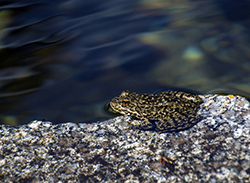
    A black-speckled, brown frog rests on a flat granite rock next to a deep blue lake

    It does not take a leap of faith to believe that CDFW scientists have gained the upper hand in bolstering the population of yellow-legged frogs in the High Sierra.

    Over the past three decades, Sierra Nevada yellow-legged frogs have become imperiled in California due to the two-pronged impact of introduced (non-native) trout and chytridiomycosis, a disease that is affecting amphibians worldwide.

    Past introduction of non-native fish, including rainbow trout and golden trout, to benefit sport fishing in the High Sierra took a heavy toll on the species. High-elevation lakes where these frogs once flourished were largely fishless until fish stocking came into vogue. As the years passed, scientists determined that these introduced fish were depopulating the frogs by competing for food sources (primarily insects) and by predation (trout ate both adult frogs and their tadpoles). Chytridiomycosis, which affects many frog species, also impaired the ability of the Sierra Nevada yellow-legged frog’s skin to exchange vital nutrients, which often leads to death.

    As a result, Sierra Nevada yellow-legged frogs are believed to have vanished from approximately 92 percent of their historical habitat, and halting and reversing that decline has become an important goal of CDFW, as well as other state and federal entities.

    “This is an animal that only lives in the Sierra Nevada,” said Sarah Mussulman, a CDFW senior environmental scientist. “It is one of our unique California species that lives in high-elevation areas, and as an amphibian it serves as an important link between the terrestrial and aquatic ecosystems. This link is especially critical in the low nutrient, granitic basins of the High Sierra, where frogs and tadpoles consume insects and algae and are themselves consumed by a variety of snakes, birds and mammals.”

    CDFW recently completed two projects as part of its ongoing efforts to reverse the population decline of Sierra Nevada yellow-legged frogs.

    The efforts took place at two sites: Highland Lake and Clyde Lake, located approximately seven miles apart on the Rubicon River in the Desolation Wilderness area of El Dorado County. The projects were completed with federal grant funds earmarked for the recovery of endangered and threatened species (the species is listed as threatened by the State of California and as endangered by the U.S. Fish and Wildlife Service).

    Highland Lake, along with its outlet, an unnamed stream, and two small adjacent ponds, supported a small population of rainbow trout when the project began in 2012. Trout abundance had declined in the absence of stocking in recent years but sufficient natural reproduction occurred in the inlet to Highland Lake to sustain the population. CDFW began using gill nets to remove rainbow trout -- the descendants of fish planted in the lake by CDFW from 1935 to 2000 -- in 2012, in partnership with Eldorado National Forest personnel.

    During a frog-monitoring survey at Highland Lake in 2016, approximately 800 adult frogs were observed, as compared to a 2003 survey in which only a few tadpoles were observed. Because the frogs have consistently survived in this area despite the presence of chytridiomycosis, scientists believe they have a good chance at persisting in the area for a long time.

    “Highland really had a population explosion over the past five years and can be counted as one of the most successful projects of this type ever undertaken,” Mussulman said.

    The project at Clyde Lake was smaller and had somewhat different factors.

    Golden trout, which frequently have the same negative impacts on Sierra Nevada yellow-legged frogs as rainbow trout, including predation and competition for food sources, were planted by CDFW at Clyde Lake from 1932 through 2000.

    Once stocking was halted, the golden trout proved less resilient then the rainbow trout at Highland Lake, due to habitat factors.

    “Clyde Lake sits in a north-facing granite bowl bordered by 1,000-foot cliffs, and no flowing streams enter the lake,” explained Mussulman. “There was no spawning habitat, which is likely why golden trout did not persist there after stocking was halted.”

    The stream flowing out of Clyde Lake and four nearby ponds did support a small population of golden trout after plants were halted. The fish in the stream and ponds, which are self-sustaining populations, are precluded from moving from the stream into Clyde Lake by a fabricated dam. In 2013, frogs and a few tadpoles were observed in the stream alongside fish, and CDFW began removing the fish from the stream with gill nets to provide additional habitat for the frogs.

    Nine years of monitoring data collected by CDFW scientists indicate that the area’s Sierra Nevada yellow-legged frog population, while small, is slowly increasing. Surveyors observed more than 120 frogs in 2016, compared to a low of six observed in 2005. Moreover, in 2016, for the first time, dozens of tadpoles were observed in the newly fish-free lower reaches of the stream.

    “It is great to see these populations recovering,” Mussulman said. “It is a great privilege doing this work that helps keep these frogs on the landscape.”

    CDFW photos: Highland Lake in the Desolation Wilderness, and a Sierra Nevada yellow-legged frog

    Categories:   General

    The latest issue of California Fish and Game, 103-3, makes a significant contribution to the body of research related to longfin smelt in California. A paper titled, “link opens in new windowHistoric and contemporary distribution of Longfin Smelt (Spirinchus thaleichthys) along the California coast (PDF)” analyzes and presents observation data for this species from a variety of published and unpublished sources dating from 1889 to 2016. This anadromous fish, which is listed as threatened under the California Endangered Species Act, has been documented in a diverse range of habitats, including coastal lagoons, bays, estuaries, sloughs, tidal freshwater streams and nearshore habitats. In addition to providing a comprehensive look at the existing information available for longfin smelt along the California coast, this paper identifies additional information needed to improve management and enhance recovery of the species within the state.

    In “link opens in new windowDistribution and derivation of dabbling duck harvests in the Pacific Flyway (PDF),” the authors look at abundance, banding and harvest data from throughout the Pacific Flyway and other important source areas in the Central Flyway to estimate the distribution and derivation of Pacific Flyway dabbling duck harvests during 1966−2013. The Pacific Flyway has long been considered an important wintering area for dabbling ducks. Better knowledge of the origins of these birds could assist in both harvest and habitat management.

    The authors of “link opens in new windowDistribution of Amargosa River pupfish (Cyprinodon nevadensis amargosae) in Death Valley National Park, CA (PDF)” endured harsh environmental conditions to document the occurrence of Amargosa River pupfish along the lower Amargosa River drainage where the species has not been previously documented. The downstream-most location of Amargosa pupfish captured in this study extends the previously recorded geographic range approximately 49 river km. The findings not only determine the distribution of Amargosa River pupfish within Death Valley National Park, but will help identify suitable locations at which to establish long-term monitoring sites.

    California Fish and Game has published high-quality, peer-reviewed science for the past 103 years, making important contributions to the understanding and conservation of California’s wildlife.

    Cover photo courtesy of Gerald and Buff Corsi © California Academy of Sciences.

    Categories:   California Fish and Game Journal

    For residents of Humboldt and Del Norte counties, the majestic Roosevelt elk is a common sight. Although Roosevelt numbers were dwindling in California by the 1920s, conservative management strategies and limited hunting opportunities have helped them to rebound. Today, researchers have identified more than 20 distinct groups of elk in these two counties, many of which consist of well over 50 animals.

    This conservation success story doesn’t come without a downside, though. Elk require large amounts of food to survive, and they tend to graze where food is most plentiful – often in agricultural areas and residential neighborhoods, where they cause damage to crops, landscaping, fencing and other private property.

    Partly in response to rising concerns about property damage caused by the Humboldt and Del Norte herds, CDFW scientists are working on a wide-ranging, long-term study of Roosevelt elk population size and growth, herd movements, habitat use, disease and causes of mortality. The project, which is a collaborative effort with researchers from Humboldt State University, will collect critical baseline information about the animals that will help CDFW develop more robust and efficient methods for monitoring the herds, set future hunt quotas, inform local agencies about elk management and manage depredation issues. CDFW initiated this project in 2016 and expects to continue data collection efforts through 2018.

    Tracking and studying one of the largest mammals in California is a much more complex undertaking than one might think. Roosevelt elk herds are wide-ranging and tend to graze in areas that are not easily accessible. Traditionally, CDFW relied on aerial surveys to monitor population trends of big game species such as elk, but such surveys are only feasible in a small portion of northwestern California because visibility is limited by steep terrain and dense vegetation. Ground surveys have similar constraints and are further limited by the small amount of occupied habitat that can be easily accessed from roads.

    Given these constraints, CDFW scientists are employing multiple survey methodologies for the current study. Different techniques will be used in different habitat types. For example, in hard-to-reach areas, trail camera footage will be compared to visual surveys and used to collect herd composition data and estimate population size. Estimates will also be derived from analyzing the DNA contained in elk droppings.

    CDFW also monitors the movement of the Roosevelt elk via electronic collars. There are currently 20 collared elk in coastal Del Norte and northern Humboldt counties and researchers hope to extend this project into central Humboldt County this winter, with plans to collar as many as 30 additional elk. Captured animals are also marked with ear tags, which allow for individual identification.

    These survey efforts, and similar efforts elsewhere in the North Coast Roosevelt Elk Management Unit (EMU), are outlined in California’s Draft Elk Conservation and Management Plan, which is available for public review and comment through Monday, January 29. The plan provides guidance and direction to help set priorities for elk management efforts statewide.

    CDFW photo: Environmental Scientist Carrington Hilson monitors a Roosevelt elk during a survey of the population.

    Categories:   General

    a pink, anenome-like flower grows next to a granite rock, under a barely visible, protective wire cage
    Lassics lupine grows under protective cages.

    a man sits beneath a pine tree on a bed of dry needles, building a small wire cage
    Richard Macedo, Habitat Conservation Planning Branch Chief constructs a cage to protect rare, endangered Lassics lupine.

    a pink flower with daisy-shaped leaves grows next to a rock, under a wire cage
    Lassics lupine grows under protective cages.

    Biologists from three government natural resource agencies banded together this summer in an unusual effort to help preserve a species under threat of extinction. They lugged materials to build wire cages into the rough terrain of the remote Lassics mountains near the border of Humboldt and Trinity counties in an effort to protect their target. However, these cages were not built to trap animals; they were constructed to keep animals out.

    The barren, green serpentine slopes of Mount Lassic, located in a seldom-visited part of Six Rivers National Forest, are home to one of California’s rarest plants: the Lassics lupine (Lupinus constancei). Lassics lupine is a short plant in the pea family that has bright rose-pink flowers. Only approximately 450 adult Lassics lupine plants were observed during 2017 monitoring of the species conducted by the U.S. Forest Service and the U.S. Fish and Wildlife Service, with assistance from CDFW.

    Rodents such as deer mice, squirrels and chipmunks have been eating so many Lassics lupine seeds from the plants that, absent intervention, the species appears to be on the path to extinction within the next 50 years (Kurkjian et al. 2016).

    Biologists believe that historical suppression of fires in Six Rivers National Forest beginning in the early 1900s may be indirectly responsible for the encroachment of forest and chaparral into Lassics lupine habitat. Fires that were put out quickly did not grow large enough to reduce encroaching forest, and therefore the forest expanded. With the encroaching vegetation came more seed-eating rodents that depend on vegetation cover for protection from predators.

    In 2003, the U.S. Forest Service, U.S. Fish and Wildlife Service and other researchers began an emergency attempt to halt Lassics lupine’s trend towards extinction. Each summer, biologists set off on the laborious hike up Mount Lassic to place cylindrical wire cages over as many flowering Lassics lupine plants as possible. Each cage is anchored to the ground to prevent rodents from squeezing underneath.

    The cages are remarkably effective at stopping rodents when properly installed, and they remain on the plants for the duration of the growing season. After Lassics lupine fruits have matured, they often split open suddenly and send seeds flying through the air up to 13 feet away. The cages are then removed each year before the onset of winter snow.

    “Protecting endangered species is California’s policy and plants like the Lassics lupine could disappear within our lifetimes,” explained Jeb Bjerke, a biologist with CDFW’s Native Plant Program. “We should do what we can to save these unique plants for the future.”

    In 2015, in the midst of an historic drought, an 18,200-acre fire spread through the Lassics, killing many Lassics lupine plants and charring the chaparral vegetation nearby. The fire had little effect on the forest that encroaches into Lassics lupine habitat, but preliminary studies suggest that the fire may have reduced rodent density in the burned chaparral. Despite the apparent reduction in rodent density following the fire, the impact from rodents eating Lassics lupine seeds remains high. Continued caging of Lassics lupine plants therefore remains critical for preventing extinction of the species until a more permanent solution can be implemented, such as significant reduction of encroaching forest. However, such efforts are expensive to plan and implement. As the primary land manager, the U.S. Forest Service would likely be the lead agency in future protective actions.

    In 2016, the California Fish and Game Commission received a petition to list Lassics lupine as an endangered species under the California Endangered Species Act and the species was designated a candidate species earlier this year. CDFW is in the process of producing a status review for Lassics lupine that will include a recommendation to the California Fish and Game Commission on whether listing the species is warranted. The legislature directs all state agencies, including CDFW, to seek the conservation of endangered and threatened species.

    “I hope that CDFW can continue to partner with the U.S. Forest Service and U.S. Fish and Wildlife Service to protect the Lassics lupine from extinction,” Bjerke said.

    For additional information on this subject, please see:

    California Department of Fish and Wildlife photos by Jeb Bjerke

    Categories:   General

    CDFW Seasonal Aid Katie Schroyer determines the age of a dove by examining its wing

    light brown mourning dove held humanely in someone's hand
    A banded mourning dove at a CDFW trap site in northern California

    a woman's hand spreads a mourning dove's wing above a notebook
    Age and sex data are recorded before the bird is banded and released.

    a wire mesh bitd trap, approximately ten-by-seven-by-seven feet, in what looks like a barnyard
    A large kennel trap can catch more than 30 birds at a time.

    As the second half of California’s split dove season kicks off, dove hunters may put more than birds in their bags. They may harvest a bird with a band on its right leg – thus getting an opportunity to contribute important data that will help guide future management efforts.

    Since 2003, California has been an active partner in a nationwide assessment of mourning dove populations. California is one of 39 states that currently participate in dove banding. During the months of July and August, trained biologists and volunteers trap and band doves throughout the state. The banding of migratory birds requires a Master Banding Permit issued upon approval of a study application by the U.S. Geological Survey. All banders must pass an annual training to participate and are then issued a sub-permit.

    Mourning doves are so widely distributed that banding operations can be – and are – located almost anywhere, from rural locations to urban backyards. Larger operations located on Wildlife Areas, ranches and open desert sites may employ the use of a large kennel trap capable of trapping 30 or more birds at a time, while smaller operations (“backyard banders”) use small Kniffin traps that catch just one or two birds at a time.

    When a bird is banded, age and sex data are recorded. This information, along with capture location, date, bander name and corresponding band number, becomes part of a massive database managed by the USGS’s link opens in new tab or window Bird Banding Laboratory. The mourning dove banding data is available to any interested party, but is mainly used by the link opens in new tab or windowU.S. Fish and Wildlife Service (PDF), university scientists and state agency scientists to analyze and estimate annual survival, harvest rates, recruitment and abundance.

    The resulting analysis is used by wildlife managers in setting annual hunting regulations. For instance, in 2015, the USFWS increased the take of mourning doves in the Western Management Unit (which includes the states of California, Oregon, Washington, Idaho, Nevada, Utah and Arizona) from a daily bag limit of 10 to 15. The California Fish and Game Commission followed suit, also increasing the possession limit from two to three times the daily bag limit, in order to accommodate hunters on multi-day hunting trips.

    If you harvest or find (encounter) a banded bird, CDFW asks that you report the number directly to the Bird Banding Laboratory. This can be done online at link opens in new tab or windowwww.reportband.gov, or by calling (800)327-2263. When reporting an encounter you will be asked for the band number and basic information about where and how you obtained the band.

    The person reporting is allowed to keep the band, and will receive a certificate with the details about where, when and by whom the bird was banded.

    The USGS Bird Banding Lab is the keeper of banding data for both the US and Mexico. As of September 18, 2017 and since 1960, the BBL has received over 64 million banding records. Since the inception of the North American Bird Banding Program, the BBL has received over 4 million encounter records. On average, over the past decade, the BBL received 1.2 million banding and 87,000 encounter records per year.

    For more information about mourning dove banding, including the 2017 Mourning Dove Harvest Strategy, visit the link opens in new tab or windowDoves and Pigeons page on the FWS website.

    CDFW photos by Kloey Helms
    Featured photo: CDFW Seasonal Aid Katie Schroyer determines the age of a dove by examining its wing.

    Categories:   General


    a healthy San Joaquin kit fox walks on a grassy field
    a San Joaquin kit fox, its face ravaged by mange
    a kit fox with mange sits on an exam table with a red calming mask on its face
    the mange-ravaged back and tail of a kit fox, with bloodied thighs
    healthy-looking San Joaquin kit fox after treatment for mange
    a kit fox with fur returning to normal after treatment for mange
    auburn-furred kit fox, held on an exam table, after mange treatment

    Fate has not been kind to the San Joaquin kit fox (Vulpes macrotis mutica).

    Shrinking habitat caused by urbanization and agricultural expansion landed this Central Valley native on the federal Endangered Species List decades ago. California’s total population of San Joaquin kit foxes may now be down to a few thousand animals. To make matters worse, its favorite food, the kangaroo rat, is likewise endangered as the desert habitat it prefers continues to disappear.

    Wildlife biologists took heart, however, in a population that seemed to be thriving within the city limits of Bakersfield. Unlike San Joaquin kit fox populations in other parts of the Central Valley range, the Bakersfield foxes adapted quite nicely to urban life. Their number – estimated between 200 and 400 animals – has evidently seemed to be holding steady and possibly increasing.

    Their cute and cuddly appearance make them popular with city residents. Earlier research showed the population was healthy and genetically robust. Wildlife biologists were counting on those urban foxes to ensure the species’ survival should kit fox populations completely collapse elsewhere.

    Today, those Bakersfield kit foxes are under siege, suffering from an outbreak of highly infectious sarcoptic mange. Mange – a skin condition caused by parasitic mites -- leads to hair loss, open wounds from scratching and, ultimately, death. The first case was detected among the kit fox population in March 2013, and since then, more than 200 cases have been documented. The epidemic has grown worse every year.

    Given the importance of the Bakersfield population, CDFW, the U.S. Fish and Wildlife Service, the California State University, Stanislaus, the University of California, Davis (UCD), and various nonprofit wildlife groups have all joined forces to combat the mange.

    Jaime Rudd, an environmental scientist in CDFW’s Wildlife Investigations Lab in Sacramento, is leading CDFW’s efforts while simultaneously writing her UCD Ph.D. dissertation on the outbreak. Rudd is researching ways to prevent mange from spreading to healthy animals, and assisting Stanislaus State’s Endangered Species Recovery Program with trapping and treating diseased foxes.

    Severely diseased kit foxes are trapped and transported to the California Living Museum, a Bakersfield wildlife rehabilitation facility and zoo. There, the kit foxes are hospitalized, given life-saving antibiotics and fluids and treated with a topical pet product that kills the mites. The foxes often need months of treatment before they are healthy enough to release. And although the intervention saves individual lives, the process is costly and time-consuming – and doesn’t prevent the treated fox from getting mange a second or third time.

    Rudd is making good use of her undergraduate degree in molecular biology, analyzing the DNA of the mites to see if they might be related to those in dogs and coyotes, which could be spreading the mange to the foxes.

    “Essentially, we want to look at their molecular signature to see if these mites are related,” Rudd said.

    Rudd is studying a group of wild kit foxes living on the CSU Bakersfield campus, which no doubt are supplementing their diet with burger bits and pizza crusts discarded by college students. Rudd is monitoring the group with trail cameras, outfitting some foxes with radio tracking collars and others with the type of preventative flea and tick collar you might use on a pet dog or cat.

    “We want to evaluate the efficacy of these collars,” she said. “If they’re only going to work for two months, the collars won’t help us slow down the spread of mange, so is it really worth the effort of putting them on? But if they’re going to work for five months or more, then it might be worth the effort.”

    If there is any hope sustaining Rudd and her colleagues in this important, though often disheartening, work, it’s this: “The fact we are not seeing mange in the outlying populations is cause for optimism,” she said. “If nothing else, we can at least try to keep it from leaving the city.”


    The top photo is a female San Joaquin kit fox with sarcoptic mange. The next six photos show a progression of mange in one of Jaime Rudd’s Bakersfield study animals, a male kit fox. The photos show a healthy animal in January 2017 before getting mange. The next three shots show him infected with mange in July 2017. The next two are four weeks after treatment for mange in August 2017. CDFW photos by Jaime Rudd.

    The last photo is another kit fox, six weeks after treatment. Photo by Erica Kelly, Endangered Species Recovery Program (ESRP), a multi-agency/university program at CSU Stanislaus.

    To see CDFW Scientific Aide Megan O’Connor release a treated San Joaquin kit fox back to the CSU Bakersfield campus, click here.


    Categories:   Wildlife Research