Project Overview
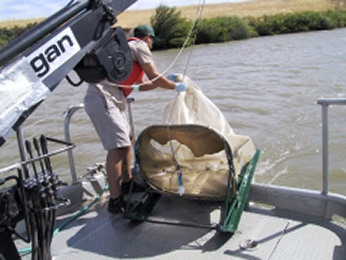
The Smelt Larva Survey (SLS) was initiated in January 2009 to provide near real-time information on the distribution and relative abundance of larval Longfin Smelt (Spirinchus thaleichthys) throughout the upper San Francisco Estuary (SFE). These data are used to determine the risk of entrainment, mostly to young of year, into the State Water Project (SWP) and the Central Valley Project (CVP) export facilities. Data from past years has been critical to the decision-making process. The Smelt Larva Survey is mandated by the California Incidental Take Permit for the State Water Project, issued by CDFW under the California Endangered Species Act and Fish and Game Code Sections 2081(b) and 2081(c), and Calif. Code of Regulations, Title 14.
Eight surveys are conducted annually from early December through mid-March, when larval Longfin Smelt are most likely to be present in the sampling range. Each survey is conducted every other week and consists of a single 10-minute oblique tow at each of the 59 stations (see map). Environmental and water quality data are recorded, and include: surface temperature, surface and benthic electro-conductivity (normalized at 25oC), water clarity, and tidal stage. Each oblique tow follows a pull schedule to sample the water column up to 40 feet, and the volume of water sampled is estimated using a General Oceanics flowmeter. Immediately after each tow, easy to identify juvenile and adult fish are identified, measured, recorded, and released back into the water. The remaining contents of the cod-end jar are preserved in 10% formalin for later identification and enumeration under a dissecting microscope at the CDFW Lab in Stockton.
The SLS net is a cone shaped net 3.35 meters in length with a mouth area of 0.37 square meters. The net is composed of 500 µm Nitex mesh (505 µm pre-2014) and includes two sections: a cylindrical front section that includes a durable canvas mouth and a funnel-shaped back section with a canvas throat that attaches to the cod-end jar. The cod-end jar is a 2L Nalgene® polyethylene bottle, screwed into a General Oceanics ring (cod-end ring), and attached to the canvas collar with a hose clamp. A 3”x4” opening is cut into the cod-end jar which is screened with 4”x5” 474 µm wire bolting cloth melted into the bottle.
Related Information