Science Spotlight

Subscribe

Receive Science Institute news by email.

    All Science Spotlight Articles

    rss

    CDFW Biologists and Scientific Aids conducting electrofishing operations to briefly stun fish so they can be identified, measured, tagged or sampled before being released unharmed.
    CDFW Biologists and Scientific Aids conducting electrofishing operations to briefly stun fish so they can be identified, measured, tagged or sampled before being released unharmed.

    Steelhead are among California's most remarkable fish. Born in freshwater streams, these ocean-going rainbow trout can migrate hundreds of miles to the Pacific Ocean before returning to the very streams where they hatched to spawn. Understanding where steelhead live, how they use habitat, and how many adults return each year is critical to conserving these iconic fish.

    “The best way to understand and support this unique species is to monitor steelhead throughout the year using a variety of scientific techniques tailored to each season,” according to Deena Hansen, the California Department of Fish and Wildlife (CDFW) senior environmental scientist supervisor who oversees steelhead monitoring across the South Coast Region for the Department in southern California.
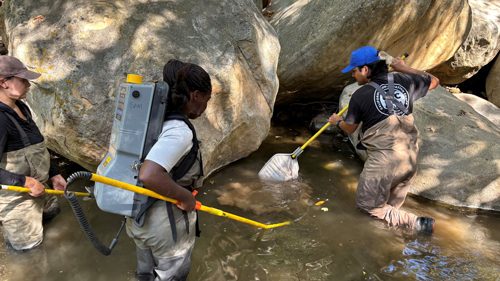
    CDFW Biologists and Scientific Aids conducting electrofishing operations to briefly stun fish so they can be identified, measured, tagged or sampled before being released unharmed.
    CDFW Biologists and Scientific Aids conducting electrofishing operations to briefly stun fish so they can be identified, measured, tagged or sampled before being released unharmed.

    Summer through Mid-Fall: Surveying Young Fish

    As weather conditions dry out and stream flows recede during the summer and fall, biologists conduct electrofishing and snorkel surveys to assess juvenile steelhead and resident rainbow trout populations. Occasionally, adult steelhead may spend their summers in freshwater, though it is less common.

    Electrofishing uses a battery-powered backpack to send a controlled electric shock into the water. The electric current temporarily stuns fish, allowing scientists to net them and transfer them to buckets. Biologists then identify species, measure individuals, evaluate their health, and document where they occur before quickly returning them to the water. In areas where water clarity and habitat conditions allow, snorkel surveys provide another effective way to observe fish in their natural environment with minimal disturbance.

    These surveys help scientists understand where steelhead are thriving, how they use available habitat, and how environmental conditions influence survival.

    Late Fall through Early Summer: Tracking the Return Home

    When rain arrives and river levels begin to rise in the fall and winter months, adult steelhead begin their migration back to freshwater to spawn.

    During this critical period, CDFW biologists conduct redd surveys, searching streams for the gravel nests, known as redds, that female steelhead construct to lay their eggs. Steelhead and rainbow trout are the same species, but while steelhead migrate from freshwater to the ocean, rainbow trout spend their entire lives in freshwater. Counting redds helps estimate spawning activity and identify important spawning habitat. Steelhead redds stand out from resident rainbow trout redds because they are typically larger, reflecting the larger size of the adult steelhead.

    In some watersheds, sonar cameras complement traditional field surveys by allowing scientists to monitor fish migrations without handling the fish. “Sonar cameras are like a fish finder, except they look across a river from bank to bank instead of down to the bottom," according to Hansen. The equipment is especially valuable in high-flowing or turbid, sediment-rich watersheds where other sampling methods may not be effective, and because it operates around the clock, it allows biologists to continuously monitor fish movement. These systems provide valuable information on the timing and number of returning adults while minimizing disturbance during spawning season.
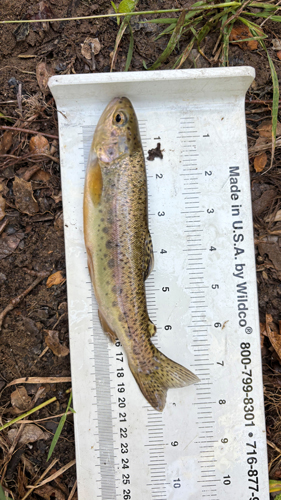
    Steelhead being measured by CDFW biologists before being released.
    Steelhead being measured by CDFW biologists before being released.

    Young steelhead develop into smolts and after spending 1 to 3 years in freshwater, they begin their migration to the ocean. This typically occurs from late winter through early summer when higher flows trigger outmigration. CDFW biologists use a variety of monitoring techniques to better understand their survival and movement. In addition to tracking juvenile steelhead as they migrate to the ocean, CDFW biologists use a variety of monitoring techniques to monitor or capture fish in different watersheds, including:

    • Acoustic telemetry: Small transmitters are attached to fish, allowing scientists to track their movements and survival as they travel through rivers and estuaries.
    • Passive Integrated Transponder (PIT) tag arrays: Tiny electronic tags implanted in fish are detected by stationary antennas, helping biologists monitor migration timing and movement without recapturing the fish.
    • Rotary screw traps: Cone-shaped traps placed in rivers safely capture downstream-moving juvenile fish so biologists can estimate abundance, migration timing and overall population trends before releasing them.
    • Seine nets: Large nets are pulled through shallow water to temporarily capture fish, allowing scientists to assess species’ composition, abundance and size before releasing them.
    • Fyke nets: Funnel-shaped nets that passively capture fish moving with the current, providing information on migration patterns and fish abundance.
    • Electrofishing: A carefully controlled electrical current is used to briefly stun fish so they can be identified, measured, tagged or sampled before being released unharmed.

    Together, these tools help scientists track steelhead as they make the critical transition from freshwater to the ocean and back, providing valuable information to guide conservation and fisheries management.

    Science Across Every Season

    No single survey tells the whole story. By monitoring steelhead life stages throughout the year, CDFW scientists build a more complete picture of population health, habitat use, and reproductive success.

    “The information collected helps guide our habitat restoration efforts, informs our fisheries management decisions, and supports conservation efforts aimed at maintaining healthy, resilient steelhead populations across California,” said Audrey Dean, one of CDFW Fisheries Branch’s senior environmental scientists that coordinates the statewide California Monitoring Program.

    Every season offers another opportunity to learn about these remarkable fish. Together, year-round monitoring helps ensure that future generations can continue to witness one of California's most extraordinary wildlife migrations.

    ###

    Media Contact:
    Cort Klopping, CDFW Communications, (916) 201-2958

    Categories:   Science Spotlight, steelhead, Wildlife Research
    burned landscape after low severity fire

    As Californians continue to face devastating wildfires, researchers are lending their expertise by producing data to inform fire policy.

    CDFW contributed an article to a recent special-edition journal featuring fire studies from around the world. CDFW’s paper shows that a mix of fire intensities, and low severity fires in particular, promote a diversity of forest carnivores like bears, fishers and bobcats. The results of the study support the value of prescribed burning in advancing ecological and societal objectives including wildlife diversity and human health and safety.

    “Wildfire is a natural part of the landscape, and we probably can’t stop it,” said the paper’s lead author, CDFW Senior Environmental Scientist Dr. Brett Furnas. “But prescribed burning is a tool we have to mimic low severity fires, which are less destructive. It’s a win-win because low severity fires have the added benefit of improving biodiversity.”

    Dr. Furnas and his team conducted the research by analyzing data from 1,500 camera traps that have been placed by scientists in Northern California forests since 2009.

    “We pulled together a large data set and compared the occurrence of 15 species of forest carnivores — including bears, fishers and bobcats — to the fire history of the landscape during that time period. The study shows our forest carnivores are well-adapted to low severity fires,” said Furnas.

    Unlike high intensity fires which tend to eradicate all trees in a given area, low intensity fires tend to thin out forests and burn mostly the understory. Prescribed burning mimics the effects of low intensity fires which are associated with ecological benefits. Other research has shown that mixed intensity fires in California have ecological benefits for birds, bees and plants.

    “The goal of the study was to use science to help inform conservation decisions,” said Furnas. “The science can help policy makers decide the best course of action and how to balance the needs of the state.”

    Media Contact:
    Ken Paglia, CDFW Communications, (916) 825-7120

    Categories:   Science Spotlight, Wildlife Research

    Some of the 160 people who assisted Fish and Wildlife with it's March 1 desert bighorn sheep survey. CDFW photo.

    man and woman using binoculars and a spotting scope to find sheep
    Charles and Nicole Lozano of Chino Hills using binoculars and a spotting scope to locate sheep. CDFW photo.

    mountains with shrubs in the fog
    The San Gabriel Mountains, north of Ontario, where the sheep survey took place. CDFW photo.

    The San Gabriel Mountains, north of Ontario, are a spectacular location for those who enjoy steep hikes and beautiful scenery. But one Sunday each year, those mountains are visited by people with a more specific agenda. They’re there to assist environmental scientists from the California Department of Fish and Wildlife in determining the number of desert bighorn sheep living there.

    On March 1, 2020, about 160 volunteers gathered near the rugged terrain for the annual sheep count. Their goal was to use spotting scopes and binoculars to locate sheep, and determine and record their gender and approximate age. The volunteers attended a mandatory training session the night before in which CDFW staff briefed them on the purpose, counting techniques and best gear and supplies to bring for what can be a long day in tough elements. And as it turned out, March 1 was the one day in a stretch of about 20 that included a forecast of rain, and the forecasters nailed it. Between the fluctuating poor conditions – including a steady rain, low clouds, strong winds and even hail – nearly every volunteer struck out on being able to locate any sheep.

    Fortunately, the annual count also includes an aerial survey the day before the boots-on-the-ground effort, and the weather was cooperative on Feb. 29. Eight CDFW employees took turns that Saturday flying in a Bell 407 helicopter over the locations where they’d likely find the sheep groups. Flights were limited to 2.5 hours before refueling was necessary. The crew of three on each flight was responsible for taking notes and guiding the pilot, using a handheld GPS to drop a waypoint at each observed sheep location, and capturing the animals with camera gear. The doors of the aircraft were removed to improve visibility for the spotters.

    CDFW Senior Wildlife Biologist and survey coordinator Jeff Villepique said a key element of the effort is determining the health of the younger animals.

    “One of the things we look at is how many lambs from last year have survived to this year,” said Villepique. “We did get some decent numbers that will help us determine the recruitment ratio and give an indication that the population is growing and doing well.”

    When CDFW first started conducting these counts in 1979, the desert bighorn sheep in the San Gabriels numbered about 740. That dropped to fewer than 200 in the late ‘90s, and currently the population is back up to about 400.  Villepique said the numbers rise and fall based on food availability, habitat loss, weather patterns and the history of wildfires.

    One group that enthusiastically supports the survey is the Society for the Conservation of Bighorn Sheep. Volunteer Debbie Miller Marschke has joined the effort multiple times, and despite the lousy weather conditions, was happy to be out in the mountains once again.

    “When you get out in the environment and you’re with positive people, it’s not a wasted day, it’s a memorable day,” Miller Marschke said, smiling as she braved the downpour. “If I stayed home, I wouldn’t remember what I did a month later. I’m going to remember this day all year long.”

    Categories:   Wildlife Research

    Logan Weyand, left, a veterinary student form Washington State University, and Drew Trausch, a scientific aid with CDFW’s Big Game Program, help capture and collar a cow Roosevelt elk in Humboldt County this past fall. CDFW photo by Shwn Fresz.

    Two CDFW staffers begin preparing a sedated cow elk for collaring and tagging in a forest
    CDFW crews work quickly to tag and collar a tranquilized cow elk in Humboldt County. CDFW photo by George Harse.

    A tagged and collared cow elk in the timber stares back at a photographer
    Sporting ear tags and a GPS tracking collar, a cow Roosevelt elk returns to heavy timber after being sedated. CDFW photo by Andrew Trausch.

    A tagged and collared cow elk stands at the edge of a meadow
    Ear tags provide biologists with visual identification of Roosevelt elk study animals while GPS tracking collars can provide years worth of detailed date on movement and habitat preferences. CDFW photo by George Harse.

    State biologists are now learning a great deal about California’s largest land mammal.

    Roosevelt elk are one of three subspecies of elk native to California, joining the tule elk (the smallest of the three) and the Rocky Mountain elk. While a bull Rocky Mountain elk will have larger and more impressive antlers, the Roosevelt elk bests it in body mass. A bull Rocky Mountain elk can reach 700 pounds while a bull Roosevelt can exceed 1,000 pounds.

    Despite their massive size and majestic appearance, Roosevelt elk have proved an elusive research subject because of the dense forests they inhabit. Aerial surveying and trapping – standard tools for counting and collaring deer, elk and bighorn sheep in more open parts of the state – can be challenging for Roosevelt elk moving in and out of heavy coastal timber.

    While deer often can be darted and tranquilized using a biologist’s truck as cover, Roosevelt elk are more wary and vehicle-shy, often requiring a lengthy stalk and serious hunting skills to get within the 50-yard effective range of a dart gun. In some cases, it can take more than 100 hours to capture and collar an individual Roosevelt elk.

    In an attempt to close the knowledge gap, CDFW recently initiated one of the largest Roosevelt elk capture and collaring efforts in state history, targeting a population of Roosevelt elk living along the U.S. 101 corridor in Humboldt and Del Norte counties. The effort is part of an ongoing study that began in 2016, explained Carrington Hilson, CDFW’s lead elk research biologist on the north coast. The study will continue through 2025.

    Since November, Hilson and her colleagues have affixed GPS tracking collars on 24 cow Roosevelt elk in Humboldt and Del Norte counties to monitor their movements and migrations. CDFW biologists plan to collar another 14 cows this winter.

    Several ancillary projects – estimating populations using fecal DNA, looking at calf survival and understanding habitat use – are also underway at Humboldt State University in Arcata in coordination with CDFW that will add to the state’s body of knowledge.

    A few factors are driving the research interest, explained Kristin Denryter, the Sacramento-based senior environmental scientist who oversees CDFW’s Elk and Pronghorn Antelope Program. The first is an increasing number of human-elk conflicts along the U.S. 101 corridor that include vehicle collisions, property damage and agricultural losses suffered by north coast farmers and ranchers.

    The second driver is technology. Advances in GPS tracking collars make them an increasingly valuable research tool. The new elk collars will record data every six hours over the life of the study and deliver that information daily to CDFW biologists.

    Lastly, there is the California Essential Habitat Connectivity Project and U.S. Department of the Interior Secretarial Order 3362 (SO 3362).

    Signed in 2018, SO 3362 directs federal agencies to work with California and other western state wildlife agencies to improve the quality of big-game winter range habitat and migration corridors on federal land. The order provided funding for CDFW to acquire the 38 GPS tracking collars and accelerate its research efforts. The collar data will improve understanding of movement and habitat use to inform habitat enhancement on public lands as well as help guide development of potential crossing structures to not only improve habitat connectivity but to also improve public safety by reducing vehicle collisions. CDFW has partnered with CalTrans on improving connectivity as part of the California Essential Habitat Connectivity Project.

    A Roosevelt elk stakeholder group made up of CDFW representatives, tribal interests, farmers, ranchers and local officials is also being developed.

    Official estimates put the Roosevelt elk population along the U.S. 101 corridor in Humboldt and Del Norte counties at 1,600 animals. Biologists, however, suspect those estimates to be low. In an attempt to reduce growing human-elk conflicts, CDFW issued 20 additional Roosevelt elk tags during the 2019 hunting season through its SHARE program, which provides public hunting opportunities on private land through cooperating landowners. CDFW is currently petitioning the California Fish and Game Commission to increase the allotment of Roosevelt elk tags available along the north coast in the 2020 fall hunting season.

    Translocations, limited hunting, high calf survival, and conservation management have all helped boost Roosevelt elk populations from lows in the early 1900s to a robust statewide estimate today of 5,700 animals. Roosevelt elk also occupy parts of Mendocino, Trinity, Shasta, Tehama and Siskiyou counites.

    The U.S. 101 corridor population in Humboldt and Del Norte counties has proved particularly adaptable – as comfortable roaming the beaches of state parks as they are grazing in open alfalfa fields or wandering underneath the forest canopy. That’s made them especially popular with tourists and some locals but not so much with farmers and ranchers suffering property damage and crop losses from the expanding herds.

    Categories:   Wildlife Research

    2 female forensic specialists examine tusk
    Forensic Specialists Kelly Carrothers (l) and Ashley Spicer, from the California Department of Fish and Wildlife, remove samples from tusk at the La Brea Tar Pits, in Los Angeles.  

    In Southern California, there are two facilities that offer fascinating looks at the types of animals that roamed the land millions of years ago. The Western Science Center in Riverside County is home to 100,000 fossils and artifacts, all unearthed during construction of a nearby reservoir. The La Brea Tar Pits in neighboring Los Angeles County serves a similar purpose, storing a staggering 35 million prehistoric specimens discovered in and around the natural pits that continue to seep asphalt in the area.

    Both facilities gladly open their doors to tourists and school field trips. Recently, they also welcomed two California Department of Fish and Wildlife forensic scientists, who traveled from Sacramento to collect samples of ivory tusks taken from Mammoths and Mastodons for a very specific purpose. Ashley Spicer and Kelly Carrothers came to collect the samples to take back to CDFW’s Wildlife Forensics Lab in Sacramento. The lab itself serves a number of purposes. In this case, the staff are collecting ivory samples for DNA testing and identification, under the auspices of a state law (AB 96) that makes it illegal to trade ivory or rhinoceros horn.

    The Wildlife Forensics Lab maintains a species database that helps identify the origin of all kinds of ivory samples. The ability to pinpoint the source of any given ivory sample is critical when it comes to prosecuting criminal cases brought against suspected ivory traffickers.

    “Mammoth and mastodon are species that are protected under AB 96 – you cannot commercialize them,” explained Spicer. “Examining the DNA allows us to identify the species of origin for any ivory-bearing species -- mammoth, whale, walrus, warthog or hippo. So, we can first distinguish whether a sample is ivory or not ivory, and whether it’s a fake or synthetic. If it is genuine ivory, then we can test it to see what was the species of origin.”

    A key element of AB 96 was the closing of a loophole in previous laws. That loophole allowed the continued sale of tusk from mammoths and mastodons, because those animals were extinct. The exemption gave traffickers the chance to fraudulently claim that they were trafficking in legal material. Now that all forms of ivory trafficking are illegal – regardless of whether the species of origin is extinct – CDFW officials hope that an expanded DNA database will be the key to shutting down the ivory trafficking trade in California.

    “The laboratory capability we have today helps us differentiate between ivory taken from an elephant that was poached in Africa within the last few years vs. ivory that was from an extinct species like a mammoth or a mastodon,” said Captain Patrick Foy of CDFW’s Law Enforcement Division. “This is huge for us – (now) we can actually prosecute these cases and convict these criminal poachers, to make the cases we couldn’t make 10 years ago,” said Foy.

    CDFW is particularly grateful for the opportunity to obtain samples from the two Southern California facilities noted for their extensive fossil collections. “To be able to work with them (Western Science Center and La Brea Tar Pits) is a really exciting collaboration,” said Spicer. “These samples will be used for forensic testing methods, and ultimately for forensics case work that will help preserve some of our most precious natural resources.”

    ###

    CDFW Photos. Forensic Specialists Kelly Carrothers (l) and Ashley Spicer, from the California Department of Fish and Wildlife, examine tusk at the Western Science Center in Riverside County.

    Categories:   Wildlife Research