 CDFW Biologists and Scientific Aids conducting electrofishing operations to briefly stun fish so they can be identified, measured, tagged or sampled before being released unharmed.
Steelhead are among California's most remarkable fish. Born in freshwater streams, these ocean-going rainbow trout can migrate hundreds of miles to the Pacific Ocean before returning to the very streams where they hatched to spawn. Understanding where steelhead live, how they use habitat, and how many adults return each year is critical to conserving these iconic fish.
“The best way to understand and support this unique species is to monitor steelhead throughout the year using a variety of scientific techniques tailored to each season,” according to Deena Hansen, the California Department of Fish and Wildlife (CDFW) senior environmental scientist supervisor who oversees steelhead monitoring across the South Coast Region for the Department in southern California.
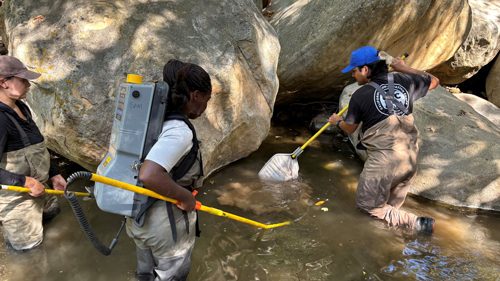 CDFW Biologists and Scientific Aids conducting electrofishing operations to briefly stun fish so they can be identified, measured, tagged or sampled before being released unharmed.
Summer through Mid-Fall: Surveying Young Fish
As weather conditions dry out and stream flows recede during the summer and fall, biologists conduct electrofishing and snorkel surveys to assess juvenile steelhead and resident rainbow trout populations. Occasionally, adult steelhead may spend their summers in freshwater, though it is less common.
Electrofishing uses a battery-powered backpack to send a controlled electric shock into the water. The electric current temporarily stuns fish, allowing scientists to net them and transfer them to buckets. Biologists then identify species, measure individuals, evaluate their health, and document where they occur before quickly returning them to the water. In areas where water clarity and habitat conditions allow, snorkel surveys provide another effective way to observe fish in their natural environment with minimal disturbance.
These surveys help scientists understand where steelhead are thriving, how they use available habitat, and how environmental conditions influence survival.
Late Fall through Early Summer: Tracking the Return Home
When rain arrives and river levels begin to rise in the fall and winter months, adult steelhead begin their migration back to freshwater to spawn.
During this critical period, CDFW biologists conduct redd surveys, searching streams for the gravel nests, known as redds, that female steelhead construct to lay their eggs. Steelhead and rainbow trout are the same species, but while steelhead migrate from freshwater to the ocean, rainbow trout spend their entire lives in freshwater. Counting redds helps estimate spawning activity and identify important spawning habitat. Steelhead redds stand out from resident rainbow trout redds because they are typically larger, reflecting the larger size of the adult steelhead.
In some watersheds, sonar cameras complement traditional field surveys by allowing scientists to monitor fish migrations without handling the fish. “Sonar cameras are like a fish finder, except they look across a river from bank to bank instead of down to the bottom," according to Hansen. The equipment is especially valuable in high-flowing or turbid, sediment-rich watersheds where other sampling methods may not be effective, and because it operates around the clock, it allows biologists to continuously monitor fish movement. These systems provide valuable information on the timing and number of returning adults while minimizing disturbance during spawning season.
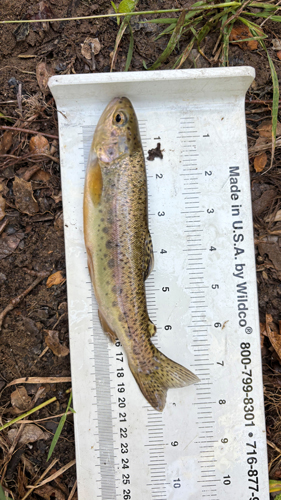 Steelhead being measured by CDFW biologists before being released.
Young steelhead develop into smolts and after spending 1 to 3 years in freshwater, they begin their migration to the ocean. This typically occurs from late winter through early summer when higher flows trigger outmigration. CDFW biologists use a variety of monitoring techniques to better understand their survival and movement. In addition to tracking juvenile steelhead as they migrate to the ocean, CDFW biologists use a variety of monitoring techniques to monitor or capture fish in different watersheds, including:
- Acoustic telemetry: Small transmitters are attached to fish, allowing scientists to track their movements and survival as they travel through rivers and estuaries.
- Passive Integrated Transponder (PIT) tag arrays: Tiny electronic tags implanted in fish are detected by stationary antennas, helping biologists monitor migration timing and movement without recapturing the fish.
- Rotary screw traps: Cone-shaped traps placed in rivers safely capture downstream-moving juvenile fish so biologists can estimate abundance, migration timing and overall population trends before releasing them.
- Seine nets: Large nets are pulled through shallow water to temporarily capture fish, allowing scientists to assess species’ composition, abundance and size before releasing them.
- Fyke nets: Funnel-shaped nets that passively capture fish moving with the current, providing information on migration patterns and fish abundance.
- Electrofishing: A carefully controlled electrical current is used to briefly stun fish so they can be identified, measured, tagged or sampled before being released unharmed.
Together, these tools help scientists track steelhead as they make the critical transition from freshwater to the ocean and back, providing valuable information to guide conservation and fisheries management.
Science Across Every Season
No single survey tells the whole story. By monitoring steelhead life stages throughout the year, CDFW scientists build a more complete picture of population health, habitat use, and reproductive success.
“The information collected helps guide our habitat restoration efforts, informs our fisheries management decisions, and supports conservation efforts aimed at maintaining healthy, resilient steelhead populations across California,” said Audrey Dean, one of CDFW Fisheries Branch’s senior environmental scientists that coordinates the statewide California Monitoring Program.
Every season offers another opportunity to learn about these remarkable fish. Together, year-round monitoring helps ensure that future generations can continue to witness one of California's most extraordinary wildlife migrations.
###
Media Contact:
Cort Klopping, CDFW Communications, (916) 201-2958