Identification
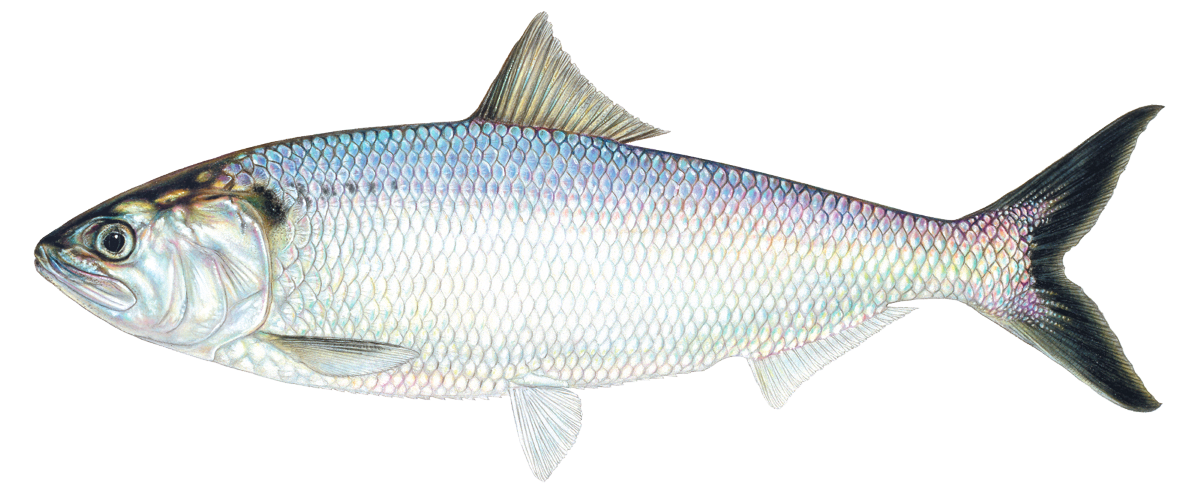
American Shad (shad) is the largest member of the herring family (Clupeidae). They can grow upwards of 30 inches and can exceed 7 pounds. Their silvery bodies are compressed from side to side but are long from their back to their bellies (dorsal to ventral). Shad have a deep fork in their tail, can have a greenish band along their back, and have a series of dark spots along their flanks. Shad scales are highly deciduous and form a sharp saw-toothed edge along their ventral side (belly).
Background
History
Shad are native to the Atlantic coast of the United States. They were successfully introduced to the West Coast through a series of plantings from 1871 to 1881.
Biology
Shad are an anadromous, pelagic cold-water species, which migrate inland to spawn. Spawning migration peaks between May and June each year. Shad are iteroparous broadcast spawners who prefer sand and gravel in main channels of rivers. Shad have the ability to mature as early as two years old. However, the average age at maturity for males and females is 4.3 years and 4.6 years, respectively. Shad produce from 98,600 to 225,000 eggs per female. Egg production in first time spawners is positively correlated to fish size, with larger females producing more eggs than smaller females. The size of male spawners range from 305-447 mm fork length (FL) and females range from 383-485 mm FL. Once a shad has returned to fresh water to spawn, they will return each year to spawn again. However, fecundity declines with each repeat spawning event. Shad are relatively long lived, with life spans spanning 7-11 years in their native ranges. The shad’s diet consists of shrimp, small crustaceans, and fish.
Distribution
American Shad range on the West Coast now spans from Kodiak, Alaska to Baja California. In California’s Central Valley, major shad runs occur on the Sacramento, American, Feather, San Joaquin, Stanislaus, and Yuba rivers and historically on the Mokelumne River. Shad can also be found in coastal rivers such as the Klamath, Trinity, Russian, Eel, and sometimes in the Smith, but in much smaller abundance than in the valley. American Shad are not frequently found south of Monterey Bay.
Angling
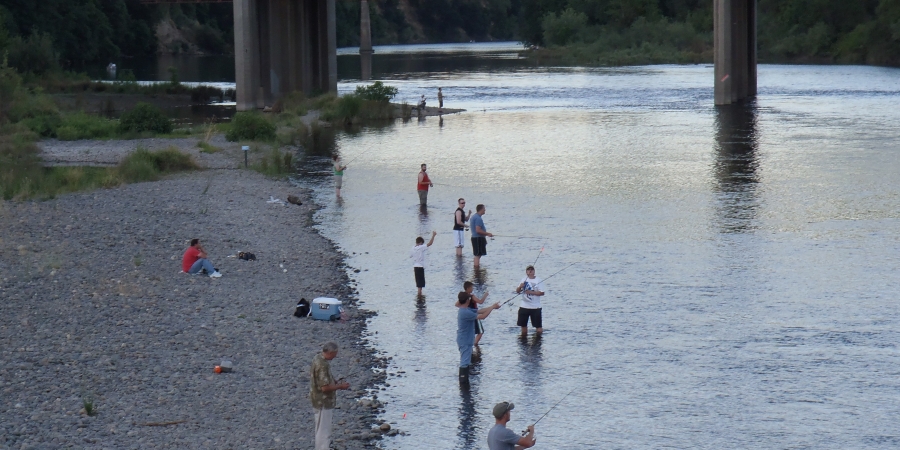
American Shad anglers fishing on the American River, Sacramento, California.
American Shad migrate upstream through California coastal and valley rivers in late spring and remain in the system through late summer. Though fisheries exist on coastal rivers, the largest fishery for American Shad can be found in the Central Valley.
Peak angling effort and catch on coastal rivers such as the Klamath, Trinity, Eel, and Russian rivers occurs in June and July.
Peak angling effort and catch on Central Valley rivers such as the Feather, American, Sacramento, San Joaquin, Stanislaus, and Yuba rivers occur between April and June.
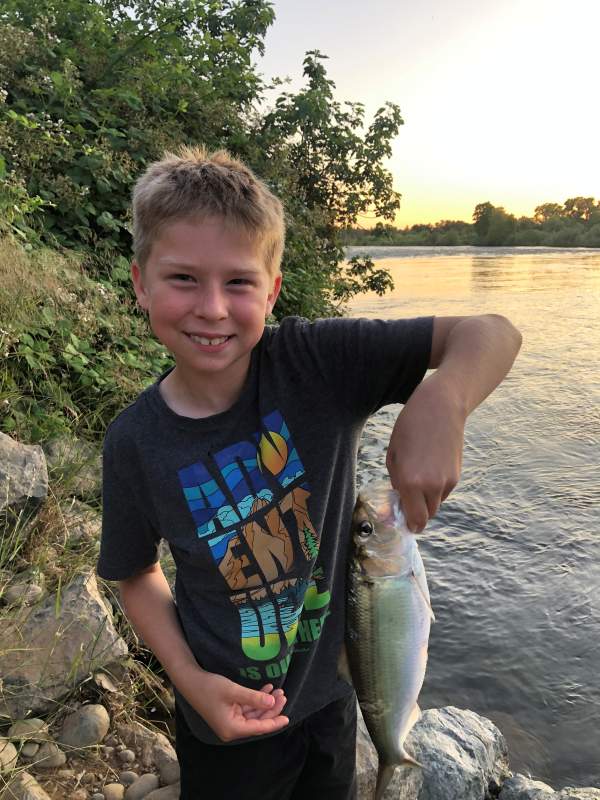 Young angler holding an American Shad he caught on the American River
Anglers can catch American Shad on light spinning or fly-fishing gear with small hooks and lures such as shad darts, flies, small plastic worms, spinners, or spoons. American Shad can also be taken by spear in waters where this method is permissive. Target shad in deep moving water where faster currents meet slow. Angling is successful from a boat or drift fishing from shore. Use a slow, steady retrieve, and let the bait swing near the bottom. Catch rates tend to be higher during periods of low light, such as in the mornings or dusk, but shad may also be caught during the day.
American Shad migrate in large schools which make them easier to catch. They also fight incredibly hard for their size and are a great species for beginning anglers.