CNDDB logo

Subscribe

Sign up to receive new posts by email.

    Search

    CNDDB News Blog

    All CNDDB Blog Posts

    rss

    Three photographs of California native plants.
    CDFW photos by Katie Ferguson

    This spring, Sacramento City College will offer a virtual version of their field botany course. This is a valuable opportunity for those new to botany to learn about the flora of California, and for veteran botanists to brush up on the basics.

    In this course students will learn how to identify many common plant families and species and learn how to use the Jepson Manual for plant identification. There will be a weekly in-class meeting via Zoom as well as pre-recorded videos. The instructor will also distribute plant specimens so that students can get hands-on experience with dissection and keying.

    If you are interested in learning more about California’s beautiful and diverse flora, 2021 might be an ideal time to take this field botany course thanks to the flexible nature of virtual learning. If you have any questions about this course, please contact Lisa Serafini at serafil@scc.losrios.edu.

    Categories:   Education and Awareness

    History Hunters logo

    Did you know that CNDDB tracks plant species that are extinct or extirpated in California? The link opens in new windowCNPS Rare Plant Inventory ranks 28 plants as 1A (extinct in California) or 2A (extirpated in California but more common elsewhere). The CNDDB maintains records on these species, with details on the locations where they used to occur and the threats that led to their extinction.

    So why continue to track these plants if they’re not around anymore? One reason is that there’s always a chance the species could be rediscovered in the future! It’s actually pretty easy for a small population of a very rare plant to escape notice for years or decades – the seeds could be waiting for just the right conditions to sprout, or the plant could be growing on private land inaccessible to botanists searching for the species.

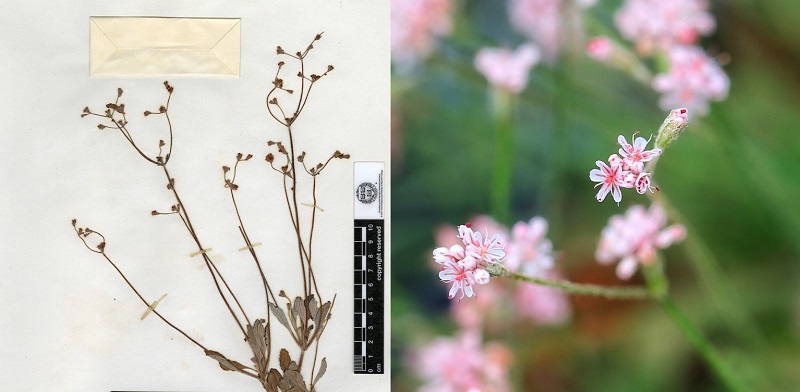
    Several plants listed as extinct in past editions of the CNPS Rare Plant Inventory have since been rediscovered. The Mount Diablo buckwheat (Eriogonum truncatum) was last seen in 1936 and presumed extinct, since introduced annual grasses had invaded its preferred habitat. In 2005, a UC Berkeley graduate student link opens in new windowrediscovered the Mount Diablo buckwheat on land recently acquired by Mount Diablo State Park.
    Photos of Eriogonum truncatum specimen and flowers
    Left: 1934 specimen of Mount Diablo buckwheat. Right: 2014 photo of rediscovered Mount Diablo buckwheat.
    Courtesy of link opens in new windowHarvard University Herbaria link opens in new window(CC BY-NC) and link opens in new windowLech Naumovich link opens in new window(CC BY-NC-SA)

    The Franciscan manzanita (Arctostaphylos franciscana) was believed to be extinct in the wild after the last known San Francisco populations were destroyed by development in the 1940s. In 2009, botanists found link opens in new windowone Franciscan manzanita shrub growing on a roadside slated for construction, and rushed to transplant it to a safe location. Most recently, a grass species last collected in Baja California in 1886, Sphenopholis interrupta ssp. californica, was rediscovered earlier this year in San Diego County.

    Even if a species is truly extinct, preserving records of where it used to occur helps us paint a full picture of California’s conservation landscape, failures and all.

    If you’re interested in becoming a botanical history hunter, and possibly rediscovering an extinct species yourself, check out the link opens in new windowCNPS Rare Plant Treasure Hunt! Every year, CNPS organizes volunteers to revisit and rediscover historical rare plant populations all over California. If you do find a botanical treasure, be sure to share your discovery with the CNDDB.

    Categories:   Education and Awareness

    Closeup of a moist Shasta sideband snail on pavement

    Every type of organism deserves our respect, especially those who were already ancient before the dinosaurs first arrived on the scene.

    When hearing "snail" most people think of a typical non-native garden snail. Nature is much more interesting than that. California boasts at least 240 named species of land snails, some of which are known only from a handful of field collections. 71 of these snails are considered imperiled and are tracked by CNDDB. Each of these species survives using staggeringly complicated biochemistry and carries along with it a long history of evading extinction by adapting at a snail’s pace.

    Since snails are often found in cool, moist environments, many of these species will face increased pressures in the coming decades due to climate change. Some of California’s snail species will likely go extinct before ever being described. The people who are remembered as the legends in a given field of science are often just the first people who decide to investigate a topic in detail. New snail discoveries are made by curious amateurs. If you want to do some cutting-edge conservation science, you may find delving a bit into malacology quite rewarding.

    The Shasta sideband snail (Monadenia troglodytes troglodytes) was originally known from a set of shells found in a cave with ice age fossils of extinct creatures such as the Shasta ground sloth. The 1933 publication that first described the shells said they belonged to an extinct species. Later research determined these snails are very much alive. They are restricted to limestone outcroppings in the vicinity of Shasta Lake. The US Forest Service now includes M. t. troglodytes on its list of sensitive species and NatureServe categorizes it as Critically Imperiled.

    The Shasta sideband shown here was found in 2017 only a few steps away from a paved public road. The next time you’re in snail country, walk slow and keep your eyes open. You never know what you might find! If you spot anything rare, be sure to share your findings with CNDDB through our Online Field Survey Form.

    Categories:   Education and Awareness

    Biogeographic Data Branch
    Physical Address: 1700 9th Street, 4th Floor, Sacramento, CA 95811
    Mailing Address: P.O. Box 944209, Sacramento, CA 94244-2090
    (916) 322-2493 | BDB@wildlife.ca.gov