Bear Naked Truth

Goings-on with black bears in the Tahoe Basin and beyond

Subscribe

Sign up to receive "Bear Naked Truth" articles by email.

    Blog Posts

    rss
    Images/OCEO/BearBlog/BearApproachingCamera.jpg

    When it comes to ordinary or outlandish black bear behavior, the Tahoe Interagency Bear Team (TIBT) has seen it all.

    Black bear deterrents that work in some parts of the country – air horns, motion-activated lighting or the loud banging of pots and pans – may be ineffective in the Tahoe Basin where bears have grown accustomed and desensitized to the sights and sounds of urban living, including car alarms, horns and music blaring from portable speakers.

    Instead, the TBIT, a collective of bear experts representing federal and state agencies in the Tahoe area, offers up the best practices and proven methods to keep Tahoe bears wild and people and property safe.

    Secure and Eliminate Attractants

    Residents and visitors have the power to prevent negative outcomes for black bears by always following the BearWise Basics. This includes properly securing garbage and recycling, removing attractants like human and pet food, grills and smokers, and bird feeders. Securing and eliminating attractants is the most important and effective long-term solution to prevent human-bear conflicts and keep bears wild.

    Electric Deterrents

    The ultimate defense against black bear break-ins and property damage is electricity. A few small businesses have sprouted up in the Lake Tahoe Basin in recent years catering to the demand for better bear-proofing.

    The “Cadillac” option for property owners is exposed electric fencing over doors, windows and other potential points of entry that provide a shock to any bear that comes into contact but does no lasting harm. Bears are smart and learn quickly to avoid such properties.

    Electrifying a whole home with exposed wiring is a significant investment costing anywhere from $3,000 to $8,000. Property owners considering this deterrent need to weigh the costs against that of their home insurance deductible or the increasingly common experience of being dropped by their insurance carrier for submitting a property damage claim. Whole-home electric fencing may make the most sense for second homes or vacation rentals that go unoccupied for periods of time.

    Electric doormats are another effective, less costly, non-lethal bear deterrent.

    Costing about $500-$600, well-placed electric mats in front of doors or below windows provide bears with a negative experience that often keeps them from coming back. Unlike whole-home electric fencing that will shock anything or anyone who comes into contact with the exposed wires, anyone wearing shoes or most types of footwear are immune from the shock of the electric mats. All these devices can be shut off when people and pets are around.

    The California Department of Fish and Wildlife (CDFW) and Nevada Department of Wildlife (NDOW) have a limited number of electric mats – what the agencies call “Unwelcome Mats” – to loan out to those experiencing human-bear conflicts in the Lake Tahoe Basin.

    A properly installed, grounded and maintained electric fence will also keep bears out of chicken coops, gardens and backyard bee hives.

    Secure That Crawl Space

    Black bears typically enter dens between mid-November and December, particularly sows that will give birth to cubs in the winter. In the Tahoe Basin, outbuildings, porches, decks, crawl spaces, RVs and vacation homes often substitute for the natural dens wild bears will typically seek out. Bears will often look for easy entry routes, like vents and doors, that they can rip open to gain access. They can fit into very small openings. Generally, if a bear can get its head inside, the rest of the bear can follow. Once underneath a house, bears will often pull down insulation or scoop up available debris for bedding. This activity often causes damage to cable and electric wiring, piping that supplies heat to the home, and water and gas lines.

    Allowing a bear to access space in your home is detrimental. This type of comfort level around humans and their properties can lead to future conflicts for you and your neighbors. It’s also imperative that female bears do not teach their offspring to seek out this sort of unnatural denning.

    Securing your crawl space now is one way to prevent an unwanted guest this winter. Openings that lead under your house and other buildings should be boarded up with thick plywood with no gaps or prominent edges that bears can use for leverage to rip off the wood. See how to properly secure a crawl space in this video.

    Dogs

    Bears don’t like them, plain and simple, and properties with a canine resident or two can experience fewer bear visits than properties without a dog around. Always ensure there is not a bear in your backyard before letting your dog out and never purposely send your dog after a bear.

    Unleashed dogs are often one of the greatest sources of negative human-bear interactions and can lead to injuries to yourself and your pet. See BearWise’s Safety Tips for Dog Owners for more information.

    NDOW uses specially trained Karelian Bear Dogs (KBDs) as a non-lethal management tool to haze bears during releases and to search for bears during human-wildlife conflicts.

    Paintballs

    Shooting paintballs at a bear on your property will force it to move along quickly and is one of the most common and effective hazing tools used by wildlife professionals in the Tahoe Basin. Aim at the rear of the bear, not the head. Avoid red-colored paintballs as some might later think the bear is injured. Many paintball markers look like firearms to the general public, so limit their use to your immediate property and not the larger community.

    Bear Spray

    Learn how to use bear spray and carry it with you outdoors in case of an aggressive bear confrontation. Remember, bear spray is designed to protect yourself from an imminent physical encounter and is not to be used as a repellent or hazing method. Bear spray is equally effective on mountain lions and coyotes.

    Scare the Bear

    BearWise offers a number of tips on why and how to safely haze a bear in its Scare the Bear digital flier that can be downloaded and printed. For more information on coexisting with bears, visit BearWise.org

    Categories:   Hibernation, Human Wildlife Conflict, Hyperphagia

    Are your bird feeders down, your BBQ clean and your bee boxes protected? If you live or maintain a residence in bear country, it’s time to prepare for spring bear activity. That means eliminating attractants that can bring bears to your mountain home and property. Even unlikely attractants such as plant fertilizer, gasoline and antifreeze can bring bears around. A bear’s nose is 100 times more powerful than a human’s and seven times stronger than that of a bloodhound. The “BearWise At Home Checklist” can help keep people, pets and property safe this spring – and bears wild.

    BearWise-At-Home-Checklist

    Categories:   Hibernation, Human Wildlife Conflict, South Lake Tahoe
    Lake Tahoe Wildlife Care sign in snowy landscape

    Within hours of receiving authorization to care for bear cubs again, Lake Tahoe Wildlife Care welcomed an orphaned, 25-pound bear cub from Tulare County to its improved South Lake Tahoe facility December 8, 2021.

    Three more orphaned cubs – two siblings from the South Lake Tahoe area and a third cub from the Coleville area in Mono County – were transferred shortly thereafter from Gold Country Wildlife Rescue in Auburn to Lake Tahoe Wildlife Care to prepare the cubs for hibernation in a high-country climate similar to where they were rescued and where they will ultimately be returned to the wild.

    “Lake Tahoe Wildlife Care is an important partner, one with decades of experience rehabilitating and releasing bear cubs back to the wild,” said Dr. Brandon Munk, wildlife veterinarian for the California Department of Fish and Wildlife (CDFW). “We’ve been working closely with them to ensure we are all maintaining the best possible standards for bear rehabilitation in this state.”

    Munk was among five CDFW employees who conducted a site inspection of Lake Tahoe Wildlife Care’s facilities December 7, 2021 prior to renewing its permit to temporarily possess and rehabilitate injured and orphaned black bear cubs.

    Lake Tahoe Wildlife Care operates under a CDFW wildlife rehabilitation permit to conduct care and rehabilitation of native wildlife -- excluding big game species such as deer, elk, and black bears. Lake Tahoe Wildlife Care had a secondary agreement with CDFW to rehabilitate black bear cubs that expired on July 22, 2021. Efforts to renew that secondary permit were temporarily delayed by the much-publicized escape this summer of a bear cub injured in the Tamarack Fire while recovering at Lake Tahoe Wildlife Care.

    CDFW required Lake Tahoe Wildlife Care to make several improvements to its facility enclosures and fencing as part of the permit renewal process to possess bears.

    Lake Tahoe Wildlife Care is just one of four wildlife rehabilitation facilities in the state permitted to care for black bear cubs, joining Gold Country Wildlife Rescue in Auburn, Sonoma County Wildlife Rescue in Santa Rosa and the San Diego Humane Society’s facility in Ramona.
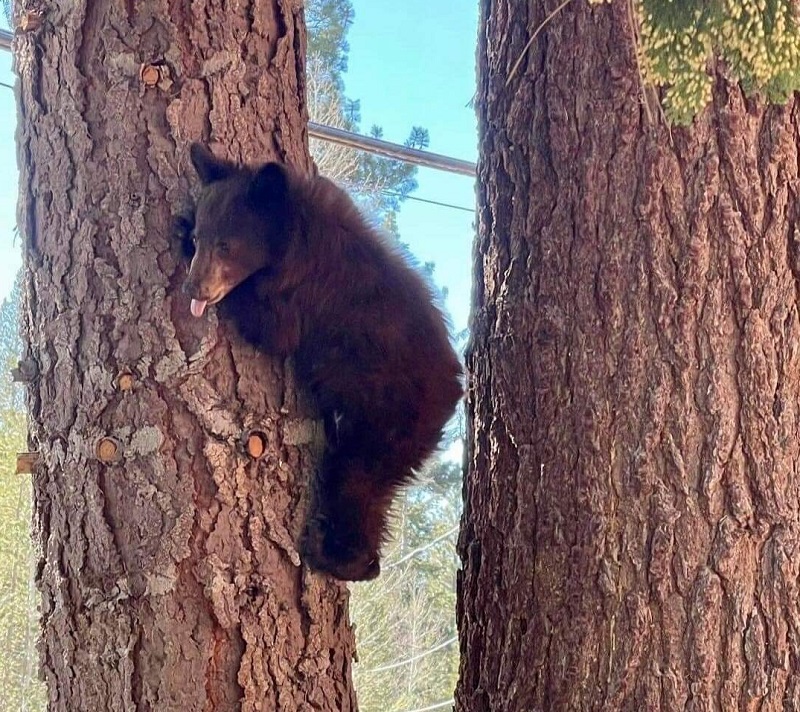
    bear cub clinging to tree trunk
    Wildlife watchers kept a close eye on this orphaned black bear cub from Tulare County before it was eventually captured and transferred to Lake Tahoe Wildlife Care in South Lake Tahoe for rehabilitation and preparation for eventual release into the wild. Photo courtesy of Lake Tahoe Wildlife Care.

    The South Lake Tahoe facility plays an outsized role in bear rehabilitation given its decades of experience and its location in the Lake Tahoe Basin, the area being a continual source of human-bear conflicts and bear issues of all kinds – from wildfires to vehicle strikes on busy Lake Tahoe-area roads.

    The fortifications to its bear enclosures are just the beginning of several improvements coming to Lake Tahoe Wildlife Care as part of a planned expansion effort.

    The facility has met and exceeded a $500,000 matching grant that will fund construction of a new wildlife animal hospital and care unit. The new facility will feature animal hospital services, a neonatal nursery, operating room and recovery rooms, along with other care and treatment spaces needed for a full-service wildlife veterinary hospital, including 24-hour care services. When completed, rescued native wildlife in the Lake Tahoe Basin can be cared for in the region’s first dedicated wildlife animal hospital. Construction is expected to begin in the spring of 2022.

    Categories:   Hibernation, Rehabilitation, South Lake Tahoe
    South Lake Tahoe home in need of securing and boarding up a crawl space underneath the house. Openings such as these can allow black bears to enter and den up for the winter.

    Openings or weaknesses in crawl spaces can be exploited by black bears looking for a warm spot to spend the winter. Property owners need to secure their properties in bear country. A black bear found this South Lake Tahoe home to its liking and set up a den underneath it for the winter. CDFW photo by Shelly Blair

    hi·​ber·​nate | \ ˈhī-bər-ˌnāt  \

    link opens in new windowintransitive verb

    1. to pass the winter in a link opens in new windowtorpid or resting state … bears hibernating in their dens
    2. to be or become inactive or dormant … let the computer hibernate

    – Merriam-Webster

    Winter has arrived in the Tahoe Basin, prompting some homeowners and visitors to let down their guard, thinking bear conflicts are over for the season with the bruins off hibernating in the forests somewhere in a deep slumber.

    Hardly, say veteran CDFW biologists. While most Tahoe Basin black bears definitely slow down and den up over the winter, some continue to access human food sources and remain active year-round.

    a lone black bear explores a porch on a South Lake Tahoe home looking for food in the winter
    A black bear explores a South Lake Tahoe front porch in winter looking for food. CDFW photo by Shelly Blair

    It’s never too late for property owners to board up any openings under homes and decks if they know there’s no bear already inside. Bears are wild animals that do not belong under cabins or houses. They can be unpredictable and potentially dangerous if they feel trapped or become startled.

    Vacation homeowners winterizing their properties should remove all food items from their unoccupied residences, including spices and canned goods. Biologists also encourage window coverings for unoccupied properties. Tahoe bears have been known to associate refrigerators and freezers with food (and can peek into homes looking for these appliances when searching for a potential meal). Tahoe residents and visitors need to remain vigilant in winter to secure food and garbage to discourage any active bears from becoming habituated and reliant on humans for food.

    Being “bear aware” is a year-round necessity in the Tahoe Basin.

    Categories:   Hibernation

    Jason Holley is a supervising wildlife biologist for the California Department of Fish and Wildlife. Based in CDFW’s North Central Region headquarters in Rancho Cordova, Holley supervises five wildlife biologists working in 12 counties -- Amador, Alpine, Butte, Calaveras, El Dorado, Glenn, Nevada, Placer, Sacramento, San Joaquin, Sutter and Yuba.

    Holley joined Lake Tahoe Television (South Lake Tahoe Channel 12/Truckee Channel 14) recently to talk about seasonal changes impacting Tahoe’s bears and steps residents need to take to keep these bears wild and free from human conflict. What follows is a synopsis of that interview.

    Lake Tahoe Television: Is hibernation starting now?

    Holley: Tahoe’s bears have been in hyperphagia (hī-pər-ˈfā-j(ē-)ə) – eating almost constantly – as they prepare for hibernation. Now they are starting to slow down metabolically and may seem lethargic as they look for their dens. So it’s a great time to make sure that your crawl spaces are properly secured because you do not want a bear using your home for its winter den.

    Lake Tahoe Television: Do bears stay asleep all winter?

    Holley: California is huge – about half the size of the entire Eastern Seaboard. Bears behave differently in different parts of the state. At lower elevations such as in Southern California, bears hardly hibernate at all. Some Tahoe bears will show some activity throughout winter. They may wake up and check out their surroundings.

    Lake Tahoe Television: Just last night I saw a bear looking for garbage at a gas station.

    Holley: Thanks for bringing that up. Residents and businesses always need to properly store food and garbage – especially in bear country. And it’s getting darker earlier now, especially with the time change. We all need to be more careful and watchful for wildlife on the drive home from work. Vehicle strikes of wildlife, unfortunately, are all too common around Lake Tahoe.

    For more information about living and recreating in bear country, please visit Keep Me Wild: Black Bear.

    A smallish, yearling black bear curls up inside a den consisting of a downed tree.
    A yearling black bear finds a winter den underneath a downed tree. CDFW photo by Sara Holm.

    Categories:   Hibernation, Hyperphagia

    Office of Communications, Education and Outreach
    P.O. Box 944209, Sacramento, CA 94244-2090
    (916) 322-8911