Science Spotlight

Subscribe

Receive Science Institute news by email.

    All Science Spotlight Articles

    rss
    CAL FIRE oversees a pile burn at CDFW's Truckee River Wildlife Area.

    CDFW and CAL FIRE have joined forces to protect public safety, public access and mule deer habitat.

    On a cool, cloudy day in February, CAL FIRE crews ignited dozens of log and brush piles within the Canyon Unit of CDFW’s Truckee River Wildlife Area adjacent to Interstate 80 in Nevada County. The piles were assembled by CAL FIRE teams over the summer – but not before CDFW biologists had carefully mapped out and flagged native bitterbrush stands to spare them from the cutting and burning (See YouTube Video).

    “Part of the resources we have on this wildlife area is this bitterbrush plant,” explained Alyson Cheney, Environmental Scientist with CDFW’s North Central Region’s Conserve Lands team. “It is really nutritious for mule deer and has been linked by scientific studies to their survival in the winter. They eat it, they use it for cover and it prepares them for their spring migration. It’s really a crucial resource for deer in the Truckee River area.”

    The Truckee River Wildlife Area supports the Loyaltan-Truckee deer herd in several important ways. It serves as a migration corridor but also as wintering habitat and stopover grounds during the herd’s migration between Nevada and California. The herd already is struggling with lost habitat as a result of wildfires and development.

    “CAL FIRE approached us about the importance of getting a fuel break on this wildlife area because of the I-80 corridor we’re right next to and the potential for ignition,” Cheney said. “We wanted to make this partnership work, but we also needed to make some nuances to the design to protect the mule deer habitat.”

    Creating a fuel break and clearing overgrown fire access roads on the wildlife area will help CAL FIRE fight and suppress catastrophic wildfire while enhancing public access and ensuring the Loyaltan-Truckee deer herd doesn’t lose additional habitat.

    “Our partnership and collaboration with Fish and Wildlife on this project is multifaceted,” said CAL FIRE Field Battalion Chief Thomas Smith. “They see benefits for wildlife and the environment right here next to the freeway. And we see benefits on our side for fire suppression and keeping access to areas where we have had historic fire along with creating a fuel reduction zone close to the highway.”

    Bitterbrush

    Part of CDFW’s statewide Wildfire Resiliency Initiative, prescribed fire at the 5,300-acre Truckee River Wildlife Area is expected to continue over the next few years as time and conditions allow.

    Sidney Fulford, another CDFW Environmental Scientist with the North Central Region lands team, explained that many of CDFW’s wildfire resiliency efforts are carried out with an eye to protect and improve fish and wildlife habitat in addition to public safety.

    Calfire CDFW

    “Whenever we’re conducting wildfire resiliency projects on state lands, we are definitely looking to balance making our habitats more fire-resilient overall while also maintaining habitat and holding onto parts of the ecosystem that are key for the wildlife out here.”

    ###

    Media Contact:
    Peter Tira, CDFW Communications, (916) 215-3858

    Categories:   Science Spotlight
    A young hunter shows off a wild rooster pheasant harvested at the Yolo Bypass Wildlife Area.

    They came from as far away as Los Angeles, Truckee and Crescent City. They showed up with their shotguns, bird dogs and blaze orange and returned over, and over, and over again.

    It was a turn-back-the-clock experience at the Yolo Bypass Wildlife Area during California’s 2024-25 hunting season. The wildlife area set a new record for its wild pheasant harvest at 687 birds and, for one season at least, rekindled memories of the Sacramento Valley as the wild pheasant hunting destination it used to be in the 1950s, 1960s and 1970s.

    “We probably had more pheasant hunters this season than the previous two years combined,” said Chris Rocco, Wildlife Habitat Supervisor I at the Yolo Bypass Wildlife Area, who has worked at the property since the California Department of Fish and Wildlife (CDFW) opened it to public use in 1996.

    “I could tell it was going to be a real good pheasant year, a fantastic year, I just didn’t anticipate it was going to be as good as it was,” Rocco said. “I was predicting 350, maybe 375 birds (harvested), but we blew past those numbers by the third week of the season.”

    The hunting public got its first glimpse of the potential not during the November pheasant opener, but rather when the area opened to dove hunting September 1. The wildlife area’s dove hunters couldn’t stop talking and texting about all the wild pheasants they were seeing.

    For more than a decade, the Yolo Bypass Wildlife Area, with the downtown Sacramento skyline as its backdrop, has been California’s top wild pheasant producer, accounting for about half of all the wild pheasants taken on public land throughout the state.

    The area’s annual wild pheasant harvest usually fluctuates within the 225 to 325 range. (Only male wild pheasants may be taken.) The previous high of 606 wild roosters was reached during the 2003-04 hunting season immediately after the wildlife area expanded and opened 5,000 additional acres to hunting for the first time. Although considerably smaller in size at the time, the wildlife area harvested just 19 roosters when it first opened to public hunting for the 1997-98 season.

    Today, the Yolo Bypass Wildlife Area is California’s largest Type A state-operated wildlife area at almost 17,000 acres. As much as 40 percent of the area consists of various upland habitats needed by pheasants, songbirds, nesting ducks, pollinators and other species. This type of habitat has largely disappeared from the Sacramento Valley landscape. Neighboring farms and private duck clubs add to the habitat footprint.

    Yolo’s expanse of upland habitat, however, doesn’t fully explain the record pheasant harvest, which more than doubled the 304 birds taken during the 2023-24 hunting season. Although the area hosts some planted-bird pheasant hunts for new hunters and youth hunters each season, those pen-raised birds aren’t included in the area’s pheasant count.

    Listening to Rocco, a combination of nature and nurture led to the record harvest.

    On the nature front, two years of wet winters and springs in 2023 and 2024 led to back-to-back flooding of the wildlife area, which is also used for flood control. That temporary flooding benefits ground-nesting birds such as pheasants, Rocco explained, as the floodwaters kill or force out the four-legged predators hardest on pheasants, particularly skunks. The upland habitat and pheasants return quickly when the floodwaters recede while the predator populations take more time to recover.
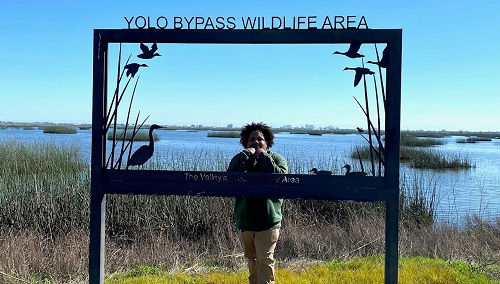
    CDFW Seasonal Aid Darian Marico Clark-Stinson stands behind the Yolo Bypass Wildlife Area metal sign.
    CDFW Seasonal Aid Darian Marico Clark-Stinson stands behind the Yolo Bypass Wildlife Area metal sign.

    “Normally, we are lucky to have two hatches, but we actually had three hatches this last year,” Rocco said. “We had birds coming off the nest in August, which is not common. And the survival rate was so high I was seeing broods of eight to 10 chicks.”

    Video: Not just pheasants! The Yolo Bypass Wildlife Area set an all-time-high harvest for geese and cinnamon teal in 2024-25. The area’s mallard harvest at 844 birds was the second-highest total in area history. CDFW’s Darian Marico Clark-Stinson has the complete season recap, including free roam and blind totals, in a special “Yolo Alert” report.

    On the nurture front, the Yolo Bypass Wildlife Area team, led by CDFW Senior Environmental Scientist Supervisor Garrett Spaan, applies a light farming touch to the landscape, leaving edge habitat for protective cover and wildlife travel corridors, integrating water into upland fields to foster broadleaf vegetation that produces the invertebrates, notably grasshoppers, pheasant chicks and other bird species need in the early stages of their lives.

    “Even in dry years, it’s important for us to maintain adequate summer wetland habitat and wetland irrigation for moist soil management across the area to benefit pheasants and other wetland-dependent species,” Spaan said.
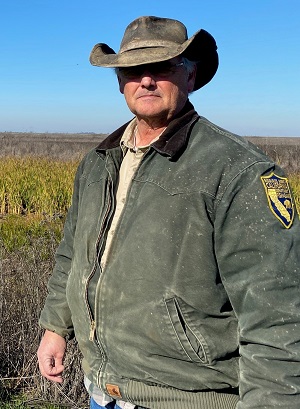
    CDFW's Chris Rocco.
    CDFW's Chris Rocco.

    Part of the habitat management strategy is also practical necessity. The area has only three full-time employees working in the field and five seasonal employees to manage CDFW’s largest Type A land holding.

    “We’re dirty farming out here,” Rocco said. “It’s kind of the old-style farming where everywhere you have a ditch, you have vegetation growing on it. Everywhere you have a fence, you’ve got a windrow growing on it. You’ve got the edges of fields out here you can’t get water to or you can’t disk, so we just leave it. That’s when you get wildlife utilization.”

    Rocco takes pride in the area’s wild pheasant numbers as an indicator of healthy uplands.

    “Everyone is talking about our pheasants right now, but we’ve got Swainson’s hawks everywhere, we’ve got a massive deer population here with some monster bucks just hanging out. We’ve got turkeys coming in, giant garter snakes and a lot of endangered species out here,” Rocco said. “This is a wildlife area in the broadest sense, and we manage it so that everything benefits.”

    Yolo Bypass Wildlife Area Wild Pheasant Harvest Through the Seasons

    2024-25 – 6872020-21 – 306

    2023-24 – 3042019-20 – 229

    2022-23 – 2632018-19 -- 361

    2021-22 – 2192017-18 – 185

    Media Contact:
    Peter Tira, CDFW Communications, (916) 215-3858

    Categories:   Science Spotlight
    Three Bumble Bee Atlas staff receiving award

    CDFW Photo: The Western Section Wildlife Society president Randi McCormick and Atlas staff (Sardinas, Richardson and Winkler) receiving the Conservationist of the Year award at the 2023 conference.

    Yellow faced bumble bee on a stick
    CDFW Photo: Yellow-faced bumble bee.

    Person taking a photo of a chilled bumble bee.
    CDFW Photo: Community science volunteer photographing a chilled bee at an Atlas field training.

    The California Bumble Bee Atlas (Atlas), a collaborative community science project developed to track and conserve the state’s native bumble bee species, has been awarded Conservationist of the Year by the Western Section Wildlife Society.

    The award, given to a person or group that has made an outstanding contribution to wildlife conservation in California, Nevada, Hawaii or Guam, was presented by the Western Section at its meeting earlier this year.

    “It’s an honor for the California Bumble Bee Atlas to be recognized for its contribution to conservation and a testament to the power of community science in addressing critical issues like pollinator decline,” said Hillary Sardiñas, statewide pollinator coordinator for the California Department of Fish and Wildlife (CDFW), and one of the scientists behind the Atlas.

    CDFW was awarded funds through the competitive State Wildlife Grant Program to support the Atlas, which is led by CDFW in partnership with The Xerces Society for Invertebrate Conservation (Xerces). CDFW and Xerces staff developed a website to compile resources for volunteers, recruited and trained community scientists from around the state and are using data gathered to help identify priorities for bumble bee conservation in California.

    Bumble bees are charismatic and easily recognizable pollinators thanks to their large size and distinctive striped patterns. Bumble bees are predominantly black and yellow but can have red, orange or white coloration. They play an important role in keeping the environment healthy by pollinating flowers in natural areas and contributing to successful harvests on farms.

    Recent declines of pollinator populations have drawn attention to their importance in providing ecosystem services, including to over 30% of agricultural crops. In California, eight of the state’s 25 bumble bee species are classified as endangered or vulnerable by the International Union for Conservation of Nature (IUCN).

    “Many bumble bee species are in a precarious position due to interacting threats, including habitat loss, climate change and disease spread. The California Bumble Bee Atlas can help track population trends to help identify species and locations for targeted conservation actions,” said Leif Richardson, Atlas lead for Xerces.

    To improve understanding of trends in bumble bee populations, Atlas staff train volunteers to collect data without harming bumble bees. Volunteers net bumble bees then chill them to take close-up photos that enable identification. The bumble bees then slowly warm up and fly away. All data and photos are uploaded to the website Bumble Bee Watch, where species are identified by expert taxonomists.

    Over 2,000 people have registered for the Atlas as volunteers. These volunteers have conducted thousands of surveys across the state and are the driving force behind the Atlas. Between 2022 and 2023, volunteers and project staff recorded 10,009 bumble bee observations.

    “The Atlas wouldn’t be possible without the support of community science volunteers, which have included a number of CDFW staff from around the state. We’re still looking for new volunteers to survey bumble bees and help contribute to this important project,” added Dylan Winkler, CDFW scientific aid for the Atlas.

    Going forward, the Atlas will have a new objective: to identify long-term monitoring sites that volunteers visit multiple times a year. This data will provide short- and long-term trends in high-priority locations that support or historically contained California’s bumble bees of greatest conservation need. All data collected from the project will help with the development of a management plan for bumble bees in California, which CDFW and Xerces hope will continue to catalyze conservation of these charismatic and important species throughout the state.

    For more information or to get involved, visit the Atlas’ website at cabumblebeeatlas.org.

    ###

    Media Contact:
    Amanda McDermott, CDFW Communications, (916) 738-9641

    Categories:   Science Spotlight
    Images/Game/BlackBear/black-bear_AdobeStock_403065323.jpg

    CDFW’s existing black bear management plan was last updated in 1998 and there have been significant advancements in scientific methodologies and wildlife population modeling since then. The new conservation plan incorporates these advancements and includes contemporary scientific methods like using an integrated population model to determine population sizes and trends. Integrated population models use multiple sources of data, are robust enough to account for changes in hunting opportunity and produce accurate estimates of California’s black bear population size. This approach allows the Department a strong basis for effective and evidence-based conservation and adaptive management.

    The draft plan also calls for the creation of nine different Bear Conservation Regions throughout the state where bear populations would be monitored and potentially managed based on specific needs.

    Among the goals identified in the draft plan are conserving the state’s black bear population and their habitats, recognizing black bears as an important game species and offering more educational and safe viewing opportunities for the public while minimizing human-black bear conflict.

    In the coming weeks, CDFW will host a virtual informational public meeting to provide an overview of the draft plan. The most up-to-date information regarding this meeting will be posted on CDFW’s Public Notices and Meetings web page when the information becomes available.

    Please locate the draft plan and options on how to provide public comment on the CDFW Black Bear page. CDFW is asking for comments to be provided by June 14, 2024.

    Categories:   General
    Matt Johnson receives the

    The National Oceanic and Atmospheric Administration (NOAA) has recognized a CDFW senior environmental scientist for his role in the historic effort to return endangered winter-run Chinook salmon to the McCloud River for the first time since construction of the Shasta Dam in the 1940s.

    Matt Johnson, CDFW’s fisheries supervisor for the winter-run Chinook salmon reintroduction pilot project, was given NOAA’s Partner in the Spotlight Award on Jan. 25, 2024. Johnson oversaw many of the project’s critical components including remote site incubation, trapping of juvenile winter-run and coordinating with project partners including the Winnemem Wintu Tribe.

    “It was a surprise and an honor. I threw myself 100 percent into the project so I’m appreciative of the recognition. The project turned into a fascinating and unique opportunity to do something new and historic. It was all unexpected,” Johnson said.

    The project launched in summer 2022 in response to drought conditions affecting Shasta reservoir and the lower Sacramento River downstream of Shasta reservoir. Multiple years of severe drought drastically reduced cold-water storage that endangered Chinook needed to live and spawn. CDFW, NOAA, Winnemem Wintu Tribe and the U.S. Fish and Wildlife Service (USFWS) partnered to move winter-run eggs upstream to the McCloud. The river offered favorable habitat including summer cold water conditions required for spawning but was inaccessible to fish because of the dam.

    Partners initially relocated about 20,000 fertilized winter-run Chinook salmon eggs from USFWS’ Livingston Stone National Fish Hatchery near Redding. The eggs were transported 80 plus miles to the banks of the McCloud where the species historically spawned prior to construction of the Shasta Dam. The eggs were then placed in specialized incubators. In early August, another 20,000 eggs were transferred to the incubators.

    The eggs were released into the river as fry, which were then collected in rotary screw traps and fyke nets, which are devices used that safely capture small salmon. Once collected, the fry were transported downstream of Shasta Dam and successfully released into the Sacramento River so the fry could migrate to the Pacific Ocean.

    “Matt and his CDFW colleagues truly went above and beyond to return winter-run Chinook salmon to their historical home in the McCloud River for the first time in over 80 years. It’s clear that this was not just a job for him – he cares deeply about these species, this river, and this ecosystem and he put his heart into bringing them back,” said Brian Ellrott, NOAA’s Central Valley Salmonid Recovery Coordinator.

    “Matt is dedicated to ensuring that this historic winter-run salmon pilot project succeeds. He recognized the insight and history the Winnemem Wintu Tribe provided and embraced their contribution to the reintroduction of the McCloud winter-run salmon,” said CDFW Director Charlton H. Bonham. “Matt is humble and passionate about his profession and we’re proud that he is part of our CDFW family.”

    Johnson added: “I couldn’t have done any of this without my team. We were a small but dedicated crew and we were fortunate to have support from management, NOAA, the Winnemem Wintu Tribe, UC Davis and the Mount Shasta Fish Hatchery. Seeing an iconic California species returned to its historic habitat after a nearly 80-year absence was pretty incredible.”

    ###

    Media Contact:
    Peter Tira, CDFW Communications, (916) 215-3858

    Categories:   Science Spotlight