CNDDB logo

Subscribe

Sign up to receive new posts by email.

    Search

    CNDDB News Blog

    All CNDDB Blog Posts

    rss

    The Biogeographic Data Branch continually works to improve our data and tools for everyone. We announced back in June that BIOS 6 has launched. Though BIOS 6 is similar to BIOS 5, there are some differences that may hang up even our most experienced users. Therefore, we want to bring your attention to several training videos and user guides that are available on our training page that may assist you in using this new tool.

    • Training videos
      • BIOS 6 Basics, BIOS 6 Tools, BIOS Advanced Tools – A series of videos that cover the background, purpose, structure, and tools in BIOS, ranging from the basic functions to the most advanced tools.
      • Accessing CNDDB and Spotted Owl Data using BIOS and RareFind – A video that demonstrates various ways our users can use BIOS and RareFind to dig deeper into the data within the CNDDB and Spotted Owl Observation Database.
    • User guides
      • BIOS 6 Getting Started – A condensed version of basic BIOS 6 functions
      • BIOS 6 Data Viewer User Guide – Full user guide of BIOS 6 functions
      • Using the CNDDB Data in BIOS 6 – A guide to a subset of BIOS 6 tools that a CNDDB user may typically use.
      • CNDDB QuickView Tool User Guide for BIOS 6 – A guide to using the QuickView Tool in BIOS 6
      • Using the Spotted Owl Reports Tool in BIOS 6 – Instructions for generating Spotted Owl reports in BIOS 6

    Please note that BIOS 5 will no longer be available starting January 2023 as we fully transition to BIOS 6. Please share with others that may need to know this information. If you have questions about BIOS 6, you can submit them to BIOS@wildlife.ca.gov.

    Categories:   Education and Awareness

    Franklin's bumble bee on a flower with long, pink petals
    Bombus franklini
    photograph by James P. Strange, USDA-ARS Pollinating Insect Research Unit, Public domain, via Wikimedia Commons

    A year ago in October of 2021, we posted about the legal status of bumble bees in California. Four of these bumble bees (B. franklini, B. crotchii, B. occidentalis, B. suckleyi) were petitioned for listing as endangered species under the California Endangered Species Act (CESA) in 2018. The California Fish and Game Commission determined that listing all four species as endangered “may be warranted” in June 2019, and the species advanced to candidacy. The Commission’s determination was challenged in court soon after, and candidacy or related protections were stayed during much of the ensuing litigation. A California court of appeal ultimately upheld the Commission’s determination, and the state Supreme Court declined to review the case. Candidacy was reinstated for all four bumble bee species on September 30, 2022. As candidate species, they receive the same legal protection afforded to endangered or threatened species (Fish & G. Code, §§ 2074.2 & 2085).

    Both the Suckley’s and western bumble bees have been petitioned for federal listing and received positive 90-day findings. The species status assessment for western bumble bee is scheduled to be released in fiscal year 2024, and Suckley’s in fiscal year 2025.

    The California Natural Diversity Database (CNDDB) tracks an additional two species of bumble bee considered species of greatest conservation need. This table includes the current status of all bumble bees tracked by the CNDDB:

    Common Name Scientific Name State
    Status
    Federal
    Status
    NatureServe
    State Rank
    Other Status
    Franklin's bumble bee B. franklini Candidate Endangered S1 IUCN Critical
    Crotch bumble bee B. crotchii Candidate None S1S2 IUCN Endangered
    western bumble bee B. occidentalis Candidate None S1 IUCN Vulnerable
    Suckley's cuckoo
    bumble bee
    B. suckleyi Candidate None S1 IUCN Critical
    obscure bumble bee B. caliginosus None None S1S2 IUCN Vulnerable
    Morrison bumble bee B. morrisoni None None S1S2 IUCN Vulnerable

    Categories:   Education and Awareness

    Two bumble bees nectaring on small white flowers
    Bombus occidentalis photograph by iNaturalist user @johnccnd (CC BY-NC 4.0) from Plumas County, California

    The California Natural Diversity Database (CNDDB) tracks 6 bumble bees (Bombus sp.) that are identified as species of greatest conservation need. Four of these bumble bees were petitioned to the State of California in 2018 and the Fish and Game Commission advanced them to candidacy in June 2019 (B. franklini, B. crotchii, B. occidentalis, B. suckleyi). This was challenged in court and in November 2020 the Superior Court ruled that insects are not eligible for listing under the California Endangered Species Act (CESA). Pending ongoing litigation, no bumble bees have legal status under CESA and none are currently considered candidates for listing by the State.

    However, effective 23 September 2021, the U.S. Fish and Wildlife Service has listed Franklin’s bumble bee (Bombus franklini) as federally Endangered. Franklin’s bumble bee has one of the smallest ranges of Bombus spp. worldwide, only known from the Klamath Mountains region of northern California and southern Oregon. Franklin’s bumble bee has faced precipitous decline. The last known detection of Franklin’s bumble bee in California was in 1998 and the last known detection in Oregon was in 2006, the latter despite regular survey efforts to historic sites. Some fear this species may already be extinct.

    Common Name Scientific Name State
    Status
    Federal
    Status
    NatureServe
    State Rank
    Other Status
    Franklin's bumble bee B. franklini None Endangered S1 IUCN Critical
    Crotch bumble bee B. crotchii None None S1S2 IUCN Endangered
    western bumble bee B. occidentalis None None S1 IUCN Vulnerable
    Suckley's cuckoo
    bumble bee
    B. suckleyi None None S1 IUCN Critical
    obscure bumble bee B. caliginosus None None S1S2 IUCN Vulnerable
    Morrison bumble bee B. morrisoni None None S1S2 IUCN Vulnerable

    Additional resources:

    Categories:   Education and Awareness

    July 16th is World Snake Day! Snakes (AKA danger noodles) shouldn't cause alarm. Usually it's humans which do them harm. When they see us they want to run away...or noodle along their own way. These elegant reptiles with elongated bodies are often misunderstood and underappreciated, and out in the wild, they are threatened by habitat loss, climate change, and disease.

    The CNDDB is currently actively working on mapping southern rubber boa (Charina umbratica) since they are under review to be listed under the federal Endangered Species Act. Other snake species that are at the top of our minds include the giant gartersnake (Thamnophis gigas), which is negatively impacted by the recent droughts in California, and the south coast gartersnake (Thamnophis sirtalis pop. 1), which has some taxonomic uncertainties that could use further research and are likely in decline due to loss of habitat in Southern California.

    How can you help these lovely creatures? The CNDDB currently tracks the following 16 snakes:

    • Southern rubber boa (Charina umbratica), State Threatened, US Forest Service Sensitive Species
    • California glossy snake (Arizona elegans occidentalis), Species of Special Concern*
    • San Bernardino ringneck snake (Diadophis punctatus modestus), US Forest Service Sensitive Species
    • Regal ringneck snake (Diadophis punctatus regalis), Species of Special Concern
    • San Diego ringneck snake (Diadophis punctatus similis), US Forest Service Sensitive Species
    • San Joaquin coachwhip (Masticophis flagellum ruddocki), Species of Special Concern
    • Baja California coachwhip (Masticophis flagellum fuliginosus), Species of Special Concern
    • Alameda whipsnake (Masticophis lateralis euryxanthus), State Threatened, Federally Threatened
    • Santa Cruz Island gophersnake (Pituophis catenifer pumilus)
    • Coast patch-nosed snake (Salvadora hexalepis virgultea), Species of Special Concern
    • Giant gartersnake (Thamnophis gigas), State Threatened, Federally Threatened
    • Two-striped gartersnake (Thamnophis hammondii), Species of Special Concern, US Forest Service Sensitive Species
    • Santa Catalina gartersnake (Thamnophis hammondii pop. 1)
    • South coast gartersnake (Thamnophis sirtalis pop. 1), Species of Special Concern
    • San Francisco gartersnake (Thamnophis sirtalis tetrataenia), State Endangered, Federally Endangered, Fully Protected
    • Red-diamond rattlesnake (Crotalus ruber), Species of Special Concern, US Forest Service Sensitive Species

    *See our previous blog post on accessing information regarding species listed as Species of Special Concern.

    If you know someone who has data on any of these snakes, send them our way! If you have found these snakes, submit your observations through our Online Field Survey Form. Together, we can help fill in knowledge gaps to better represent these species and assist with conservation.

    A rattlesnake coiled up in a hole
    CNDDB's own Ryan Elliott recently photographed this beautiful rattler after his kids named her Vivian the Viper and scared her into a hole. Ryan tried encouraging Vivian to emerge, explaining that the kids are basically harmless, but she was having none of it!

    Categories:   Education and Awareness

    A curious mind never runs short of unanswered questions. While the great mysteries remain unsolved, we can offer to shed some light on the CNDDB.

    We have gathered our most frequently asked user questions and created a new FAQ page. Topics include CNDDB lingo, data submission, tools and products, subscriptions, and more.

    If you take a look at the page and feel like you still have unanswered questions, write us an email and we will get in touch with you. If we get enough questions, we may address those in future blog posts and/or update the FAQ page.

    Categories:   Education and Awareness, General

    A bottom-up view of old-growth redwood forest at Headwaters Forest Reserve
    Old-growth redwood forest at Headwaters Forest Reserve. BLM photo by Bob Wick.

    Imagine: Trees all around you as far as the eye can see. The sounds of birds chirping and squirrels scampering about. Patches of sunlight flickering in through the branches. If you haven’t guessed it already, you have found yourself in one of the world’s most important ecosystems: a forest!

    Covering about one third of the Earth’s land surface, forests are incredibly crucial environments that provide economic, ecological, health, and recreational benefits for people around the world. After the worldwide successes in conservation and management that came from the International Year of Forests in 2011, the United Nations General Assembly declared March 21st as the International Day of Forests in 2012. The purpose of International Day of Forests is to celebrate and raise awareness on all types of forests and encourage forestry activities that help maintain and conserve them year after year. This year’s theme is Forest restoration: a path to recovery and well-being, which is particularly meaningful in California after the devastating 2020 wildfire season.

    Forests are home to almost 80% of Earth’s terrestrial species, making them the most biodiverse ecosystems on land. Approximately 1.6 billion people rely on forests for vital resources such as food, medicine, employment, and shelter; even more people utilize forests for recreational and social benefits. After all, who doesn’t love a peaceful walk or picnic surrounded by beautiful trees? Unfortunately, about 10 million hectares of forest are lost every year due to deforestation, and about 2 billion hectares face degradation. Deforestation accounts for approximately 12 to 20 percent of anthropogenic greenhouse gas emissions and puts species that need forests to survive at risk. By focusing on forest management and restoration, we can begin to combat climate change while also securing the habitats used by endangered species and continuing to provide important goods and services for people around the world.

    Here in California, we have approximately 33 million acres of forest to celebrate! Whether it is the awe-inspiring giant sequoia or the unique western Joshua tree, California boasts a variety of incredibly diverse trees and forests. Take some time to observe International Day of Forests by learning about ways you can get involved in forest conservation, visiting a local forest, or simply appreciating the trees in your neighborhood. If you happen to spot some rare California trees, be sure to submit your findings!

    Categories:   Education and Awareness

    Every year World Wetlands Day is celebrated on February 2nd, marking the date in 1971 in which the Convention on Wetlands was adopted in Ramsar, Iran. The Convention on Wetlands is an intergovernmental treaty that outlines the importance of wetlands and provides a framework on how to preserve and sustainably use these precious lands around the world. Wetlands are a crucial part of our environment as they store fresh water for our consumption and are a habitat or breeding ground for 40% of the world’s species. Important agricultural, environmental, recreational, and economical services are also provided by wetlands all over the globe.

    Wetlands are defined as lands that are near or under the water for at least part of the year, such as estuaries, saltmarshes, and mangroves. They can contain fresh or salt water and are home to plants and animals that are specially adapted to life in an aquatic environment. In California only about 5% of our wetlands remain, largely due to the fact that they have historically been destroyed for agricultural or urbanization purposes. Since many wetlands are reliant on high groundwater levels, climate change also poses a significant threat to these valuable lands.
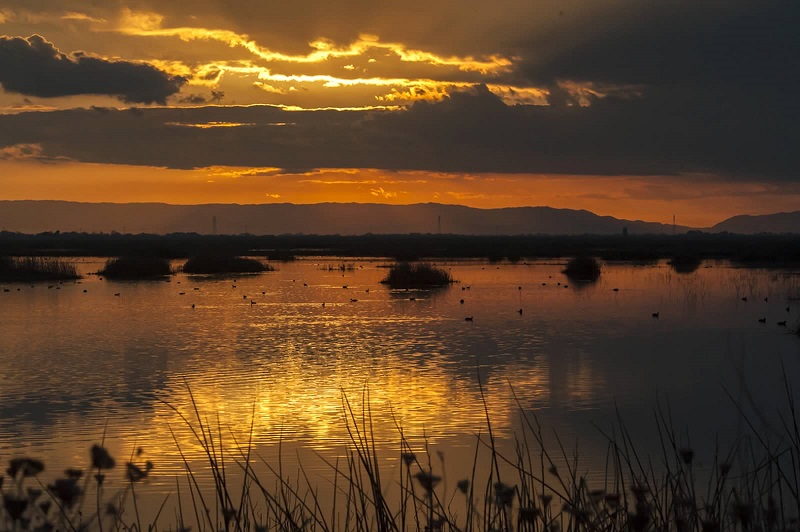
    Sunset at Yolo Wildlife Area
    Sunset at Yolo Wildlife Area. CDFW photo by Bob Sahara.

    This year’s theme for World Wetlands Day is “Wetlands and Water,” which is fitting being as these important ecosystems store most of the world’s fresh water. Wetlands play a large role in filtering pollutants and providing fresh water that we can drink or use to irrigate crops. With a global consumption of 10 billion tons of water per day, the stress placed on wetlands is high.

    Another primary function of wetlands is flood control. When extreme weather events occur, wetlands act as shock absorbers and help protect surrounding areas from flooding. In fact, each acre of wetland can absorb up to 1.5 million gallons of floodwater! These lands also store large amounts of carbon, which helps regulate the climate and lessen the severity of climate change.
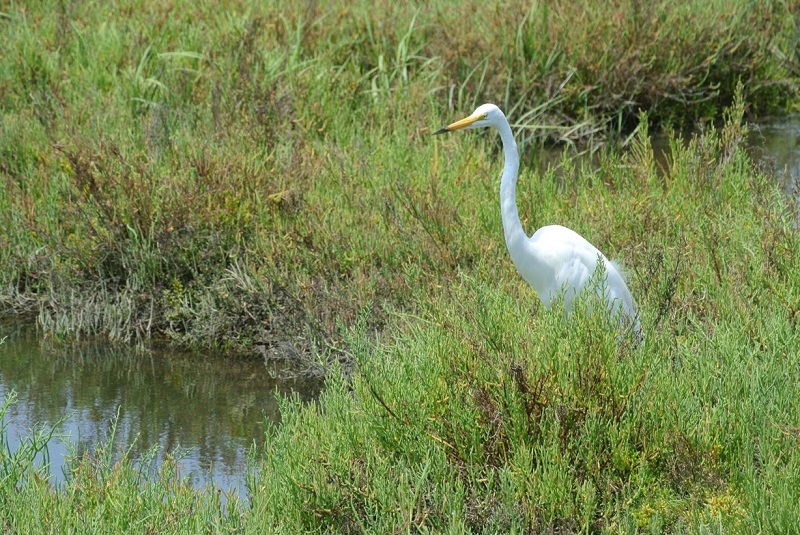
    Great egret standing in some vegetation by the water
    Great egret (Ardea alba) hunting at Bolsa Chica Ecological Reserve. CDFW photo by Kirsten Macintyre.

    Agriculturally, wetlands are important spaces for rice paddies and other forms of farming; 3.5 billion people rely on rice paddies for food annually. Aquaculture is also an important factor of wetlands. Shrimp, clams, fish, and many other aquatic organisms are grown in wetlands to help reduce overfishing in oceans and meet our increasing global demand for food. In 2016, approximately 30% of fish production was through inland aquaculture.

    Of course, wetlands are also important recreational spaces for birdwatching, photography, hunting, walking, or simply enjoying the beauty of nature. We must preserve these valuable wetlands by doing what we can to conserve water, address pollution, and raise awareness on the importance of these lands. We encourage you to visit your local wetlands with a newfound appreciation and keep an eye out for any native wildlife. If you happen to spot a rare species, be sure to report your observation through our Online Field Survey Form!

    For more information on World Wetlands Day and how to get involved, please visit the link opens in new windowOfficial World Wetlands Day website.

    Categories:   Education and Awareness

    Three photographs of California native plants.
    CDFW photos by Katie Ferguson

    This spring, Sacramento City College will offer a virtual version of their field botany course. This is a valuable opportunity for those new to botany to learn about the flora of California, and for veteran botanists to brush up on the basics.

    In this course students will learn how to identify many common plant families and species and learn how to use the Jepson Manual for plant identification. There will be a weekly in-class meeting via Zoom as well as pre-recorded videos. The instructor will also distribute plant specimens so that students can get hands-on experience with dissection and keying.

    If you are interested in learning more about California’s beautiful and diverse flora, 2021 might be an ideal time to take this field botany course thanks to the flexible nature of virtual learning. If you have any questions about this course, please contact Lisa Serafini at serafil@scc.losrios.edu.

    Categories:   Education and Awareness

    History Hunters logo

    Did you know that CNDDB tracks plant species that are extinct or extirpated in California? The link opens in new windowCNPS Rare Plant Inventory ranks 28 plants as 1A (extinct in California) or 2A (extirpated in California but more common elsewhere). The CNDDB maintains records on these species, with details on the locations where they used to occur and the threats that led to their extinction.

    So why continue to track these plants if they’re not around anymore? One reason is that there’s always a chance the species could be rediscovered in the future! It’s actually pretty easy for a small population of a very rare plant to escape notice for years or decades – the seeds could be waiting for just the right conditions to sprout, or the plant could be growing on private land inaccessible to botanists searching for the species.

    Several plants listed as extinct in past editions of the CNPS Rare Plant Inventory have since been rediscovered. The Mount Diablo buckwheat (Eriogonum truncatum) was last seen in 1936 and presumed extinct, since introduced annual grasses had invaded its preferred habitat. In 2005, a UC Berkeley graduate student link opens in new windowrediscovered the Mount Diablo buckwheat on land recently acquired by Mount Diablo State Park.

    Photos of Eriogonum truncatum specimen and flowers
    Left: 1934 specimen of Mount Diablo buckwheat. Right: 2014 photo of rediscovered Mount Diablo buckwheat.
    Courtesy of link opens in new windowHarvard University Herbaria link opens in new window(CC BY-NC) and link opens in new windowLech Naumovich link opens in new window(CC BY-NC-SA)

    The Franciscan manzanita (Arctostaphylos franciscana) was believed to be extinct in the wild after the last known San Francisco populations were destroyed by development in the 1940s. In 2009, botanists found link opens in new windowone Franciscan manzanita shrub growing on a roadside slated for construction, and rushed to transplant it to a safe location. Most recently, a grass species last collected in Baja California in 1886, Sphenopholis interrupta ssp. californica, was rediscovered earlier this year in San Diego County.

    Even if a species is truly extinct, preserving records of where it used to occur helps us paint a full picture of California’s conservation landscape, failures and all.

    If you’re interested in becoming a botanical history hunter, and possibly rediscovering an extinct species yourself, check out the link opens in new windowCNPS Rare Plant Treasure Hunt! Every year, CNPS organizes volunteers to revisit and rediscover historical rare plant populations all over California. If you do find a botanical treasure, be sure to share your discovery with the CNDDB.

    Categories:   Education and Awareness

    Closeup of a moist Shasta sideband snail on pavement

    Every type of organism deserves our respect, especially those who were already ancient before the dinosaurs first arrived on the scene.

    When hearing "snail" most people think of a typical non-native garden snail. Nature is much more interesting than that. California boasts at least 240 named species of land snails, some of which are known only from a handful of field collections. 71 of these snails are considered imperiled and are tracked by CNDDB. Each of these species survives using staggeringly complicated biochemistry and carries along with it a long history of evading extinction by adapting at a snail’s pace.

    Since snails are often found in cool, moist environments, many of these species will face increased pressures in the coming decades due to climate change. Some of California’s snail species will likely go extinct before ever being described. The people who are remembered as the legends in a given field of science are often just the first people who decide to investigate a topic in detail. New snail discoveries are made by curious amateurs. If you want to do some cutting-edge conservation science, you may find delving a bit into malacology quite rewarding.

    The Shasta sideband snail (Monadenia troglodytes troglodytes) was originally known from a set of shells found in a cave with ice age fossils of extinct creatures such as the Shasta ground sloth. The 1933 publication that first described the shells said they belonged to an extinct species. Later research determined these snails are very much alive. They are restricted to limestone outcroppings in the vicinity of Shasta Lake. The US Forest Service now includes M. t. troglodytes on its list of sensitive species and NatureServe categorizes it as Critically Imperiled.

    The Shasta sideband shown here was found in 2017 only a few steps away from a paved public road. The next time you’re in snail country, walk slow and keep your eyes open. You never know what you might find! If you spot anything rare, be sure to share your findings with CNDDB through our Online Field Survey Form.

    Categories:   Education and Awareness

    Biogeographic Data Branch
    Physical Address: 1700 9th Street, 4th Floor, Sacramento, CA 95811
    Mailing Address: P.O. Box 944209, Sacramento, CA 94244-2090
    (916) 322-2493 | BDB@wildlife.ca.gov