Mission Statement
To improve wildlife connectivity and roadway safety across California using the best available science.
Overview
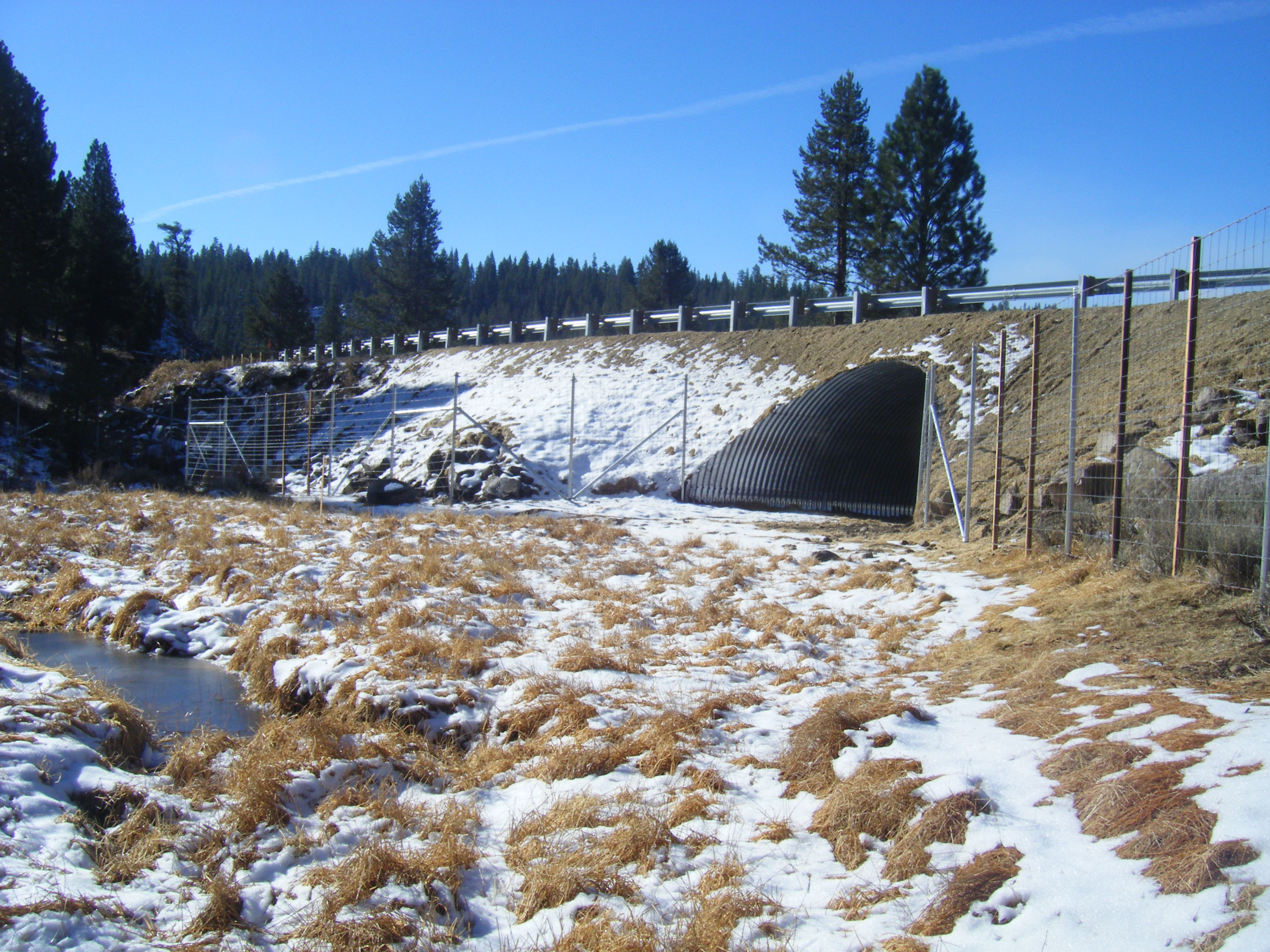 CDFW photo by Sara Holm
Connectivity is essential for wildlife, enabling animals to move, migrate, find mates, and access resources. Barriers do more than obstruct movement; they can alter natural behaviors and increase the risk of injury or death. Maintaining landscape connectivity supports natural dispersal, gene flow, and colonization of unoccupied habitat, enhancing long-term population viability and sustaining ecosystem services. Conserving and restoring corridors that link habitat patches helps alleviate pressures from anthropogenic change by facilitating safe movement and reducing mortality from vehicle collisions and fence entanglements. Connectivity is also increasingly important as species shift their distributions in response to climate change.
Over time, numerous partnerships with non-governmental organizations, local, State and federal agencies have been developed to address connectivity challenges, ranging from local efforts focused on specific barriers and crossings to statewide initiatives addressing policy and landscape-scale conservation. Staff across multiple regions and branches of the California Department of Fish and Wildlife (CDFW) have participated in these collaborations to foster coordination with external partners and implement on-the-ground conservation actions. In 2024, after the passing of AB 2344, a connectivity team was formed that included permanent staff working exclusively to improve wildlife connectivity across California. This team includes a senior scientist in each of the Department's six terrestrial regions and headquarters, and an engineer specializing in wildlife crossing infrastructure. This team is responsible for assisting Caltrans with the implementation of AB 2344, developing the Terrestrial Wildlife Connectivity Barriers Dataset, develop the California State Action plan under Secretarial Order 3362 and provide technical advice regarding wildlife connectivity to Caltrans and advance connectivity science in California.
Building on these efforts, habitat quality remains a critical component of effective connectivity. Even where corridors or crossing structures are present, degraded or low-quality habitat can limit their functionality by discouraging use or increasing energetic and predation risks. Restoration projects that enhance native vegetation, reduce invasive species, and improve forage and cover conditions can substantially increase the permeability of the landscape. By improving habitat within and surrounding movement corridors, these efforts encourage wildlife to use existing pathways and crossing structures, ultimately increasing the success of connectivity investments. In this way, habitat restoration complements barrier mitigation by not only reconnecting landscapes structurally, but also ensuring they function ecologically to support movement, gene flow, and population resilience.
Terrestrial Wildlife Connectivity Barriers
CDFW conducted an assessment of priority barriers to wildlife movement throughout the state. These barriers which are created by linear infrastructure such as roads, railways, and canals can influence wildlife movement, impede genetic exchange, cause mortality, and ultimately reduce population resilience. The assessment dataset currently includes 204 segments of linear infrastructure that have been identified as wildlife barriers, or locations where wildlife movement is known to be negatively impacted. These barrier segments comprise a total of 4914.7 kilometers of linear infrastructure. Many of the known barriers are associated with the State Highway System, but railroads, canals, dams, high-speed rail alignments, border walls, and local roads are also represented. This assessment helps direct research and funding, with the ultimate goal of improving the barrier to the point where it is removed from the dataset.