(Lewisia congdonii)
| Family |
Montiaceae (Miner's Lettuce Family) |
| Life History |
Perennial |
| Range |
Fresno and Mariposa Counties |
| CDFW Region |
Central Region (Region 4) |
| CA Listing |
Rare |
| US Listing |
None |
Background
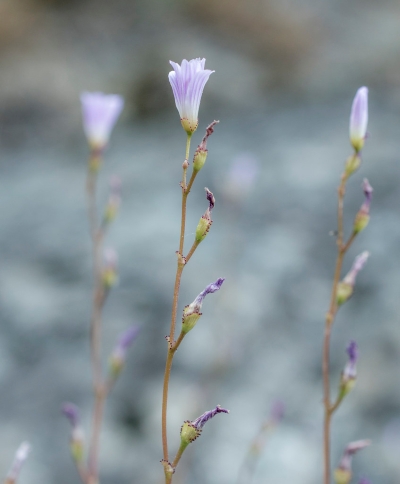 Lewisia congdonii by Jeb Bjerke. (CDFW)
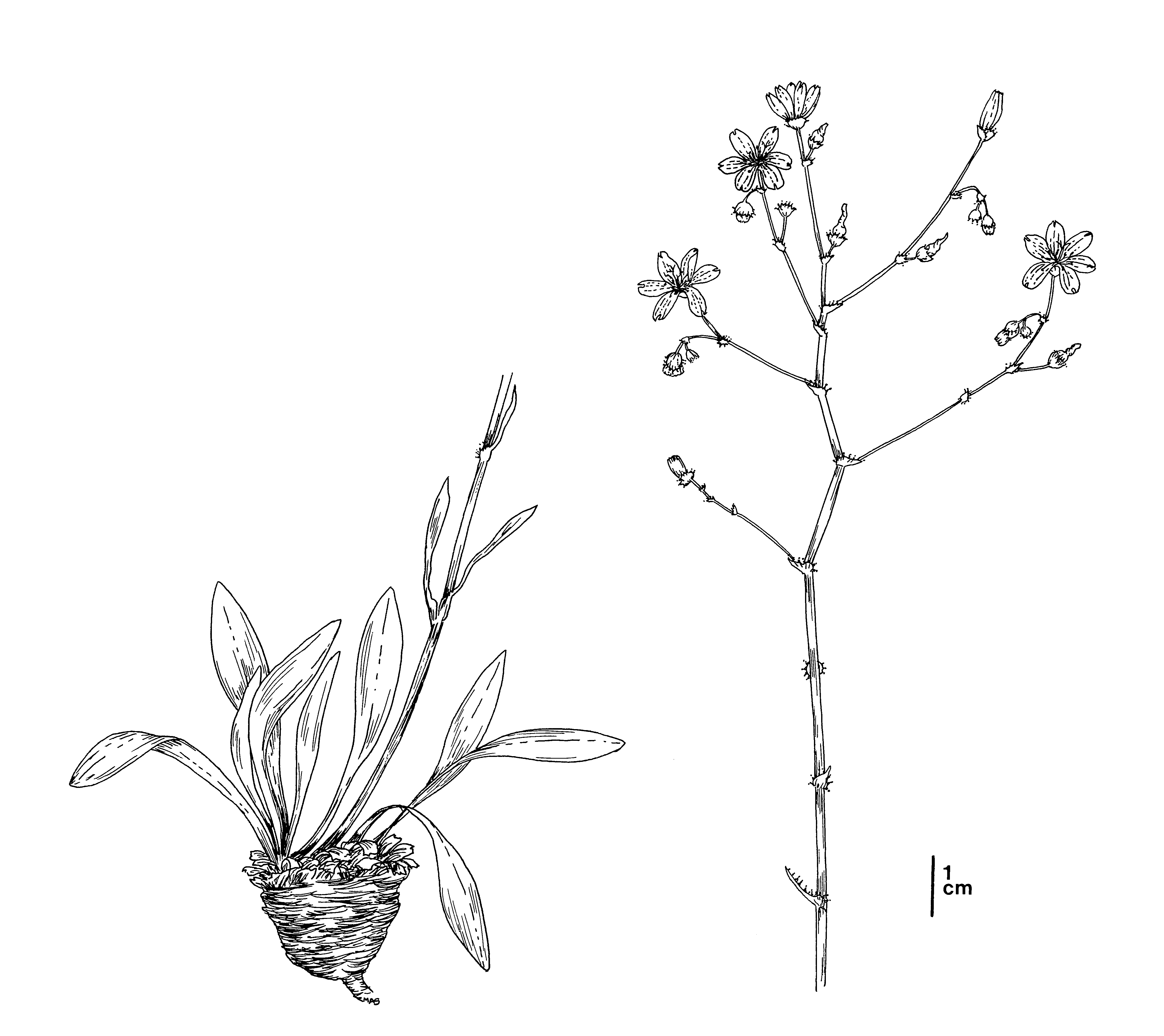 Lewisia congdonii. CDFW illustration by Mary Ann Showers. (Click to enlarge)
Congdon's lewisia (Lewisia congdonii) was listed in 1982 as a California rare plant species, which means that killing or possessing this plant is prohibited by the Native Plant Protection Act (NPPA). Congdon’s lewisia is an annual to perennial forb in the miner’s lettuce family (Montiaceae), formerly in the purslane family (Portulacaceae). The plant has a basal rosette of long, flattened, oval leaves with one to several upright, flowering stems 2 to 6 dm (8 to 24 in) tall. Each stem has a few to many flowers that bloom from April through June. The pale pink petals have deep red veins. Congdon’s lewisia has dark pink glands along the margins of the green sepals which form a cup around the base of the petals.
Distribution
Congdon’s lewisia is found only in California, in the southern Sierra Nevada Mountains, from 500 to 2,800 m (1,640 to over 9,000 ft) in elevation. It occurs in a variety of chaparral, woodland, and forest habitats but is typically found on cool and often moist, north-facing slopes, in granite or metamorphic rocky outcrops, slopes, and crevices. The California Natural Diversity Database lists 10 occurrences, all thought to be extant. All known occurrences are within the Stanislaus, Sierra, or Sequoia national forests in Mariposa and Fresno counties. Populations range from fewer than 50 individuals to over 8,000, though many populations have not been surveyed since the 1980s.
Conservation
Threats to several populations of Congdon’s lewisia include invasive species control and road maintenance since they are adjacent to highways and may be subject to herbicide spraying, road improvement and maintenance, and trash dumping. However, most populations are located away from roads. The California Rare Plant Ranking of 1B.3 identifies it as rare in California, with fewer than 20% of its occurrences being threatened. This is likely because known occurrences are in remote areas of public lands. While there are no active management programs or protection plans for Congdon’s lewisia, the species is on the US Forest Service sensitive species list for Sequoia, Sierra, and Stanislaus National Forests which affords it conservation status on Forest Service lands. The potential effects of climate change, fire, and fire management activities on this species are unknown. Up-to-date information is lacking for several occurrences, and more studies are needed to evaluate this species’ population trend.
CDFW may issue permits for Congdon's lewisia pursuant to CESA, and we invite you to learn more about the California laws protecting Congdon's lewisia and other California native plants. Populations of Congdon's lewisia occur in CDFW's Central Region.
References
- California Department of Fish and Wildlife. 2025. California Natural Diversity Database.
- Foster, M. E. Carroll, and V. D. Hipkins. 1997. Saw-toothed Lewisia: to be or not to be (PDF). Fremontia 25(1):15-19.
- Rydberg, P. A. 1932. Portulacaceae, Lewisia. North American Flora 21:327-328.
- US Forest Service. Regional Forester’s 2013 Sensitive Plant Species List. United States Department of Agriculture, Forest Service.
- US Forest Service. 2026. Endangered & Sensitive Species (website).
Updated 05/11/2026