(Carex tompkinsii)
| Family |
Cyperaceae (Sedges) |
| Life History |
Perennial |
| Range |
Fresno, Mariposa, Nevada, and Tuolumne Counties |
| CDFW Region |
North Central (Region 2) and Central (Region 4) |
| CA Listing |
Rare |
| US Listing |
None |
Background
 Carex tompkinsii by Jeb Bjerke. (CDFW)
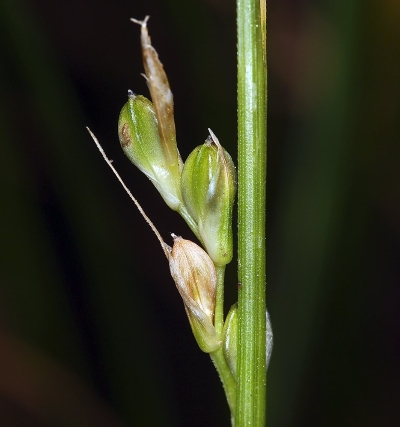 Carex tompkinsii by Steve Matson. (CC BY-NC)
 Carex tompkinsii. CDFW illustration by Mary Ann Showers. (Click to enlarge)
Tompkins' sedge (Carex tompkinsii) was listed in 1979 as a California rare plant species, which means that killing or possessing this plant is prohibited by the Native Plant Protection Act (NPPA). Tompkins' sedge is a tufted grass-like perennial in the sedge family (Cyperaceae). The density of leaves varies from loose tufts to dense clumps. Each leaf is flat, narrow, and generally between 30 to 60 cm (1 to 2 ft) long. The flowering stems may be shorter than, to slightly exceeding, the overall height of the leaves, with a single spikelet at the end of each flowering stem. The male flowers are at the tip of the spikelet, with one to a few female flowers below the male flowers. The lowest female flower has a long leaf-like bract extending beyond the tip of the spikelet.
Distribution
Tompkins' sedge is found only in California, on the western side of the Sierra Nevada Mountains, from 420 to 1829 m (1,380 to 6,000 ft) in elevation. It is commonly found in canyon live oak (Quercus chrysolepis) and interior live oak (Quercus wislizeni) woodland communities, ranging from dry south-facing rocky slopes to shady stream sides. Many of the natural populations are associated with granitic, rocky to gravelly soils. Many populations have been discovered since Tompkins' sedge was state-listed in 1979, and the species is now known to occur in a wider variety of habitat types than originally thought.
The California Natural Diversity Database (CNDDB) lists 17 occurrences, all thought to be extant. Most records are in Mariposa and Fresno counties, with a few scattered observations north into Nevada County. Most occurrences are on public land within Sequoia and Sierra national forests as well as Kings Canyon and Yosemite national parks. Many plants were transplanted along Highway 180 in the Kings River Canyon in Sequoia National Forest in the late 1990s to serve as a seed source for revegetation efforts.
Conservation
At the time of this webpage posting, 14 of the known populations are considered of unknown habitat quality and population condition due to a lack of sufficient information. In 1998, the U. S. Forest Service removed this species from its Sensitive Species list because new populations had been discovered and because most plants were believed to be growing in remote areas unlikely to experience human impacts. However, several individual national forests and parks continue to monitor and protect the species. Some populations are still threatened by road/trail construction and maintenance (including trail building and herbicide uses) and residential and commercial development. Also, fire is believed to reduce competition and appears to invigorate Tomkins' sedge plants, so fire suppression and fire management activities may pose threats to the plant.
CDFW may issue permits for Tompkins' sedge pursuant to the NPPA, and we invite you to learn more about the California laws protecting Tompkins' sedge and other California native plants. Populations of Tompkins' sedge occur in CDFW's North Central and Central Regions.
References
- Botti, S. 1990. Rare Plant Status Report: Carex tompkinsii. Prepared for the Endangered Plant Program, California Department of Fish and Game.
- California Department of Fish and Wildlife. 2025. California Natural Diversity Database.
- Clines, J., Tanner, L., Hass-Stanislaus, J., and P. Ashmead-Stan. 1998. Region 5 USFS Sensitive Plant Species Evaluation and Documentation Form. U. S. Forest Service.
- Keeler-Wolf, T., Moore, P. E., Reyes, E. T., Menke J. M., Johnson D. N., and D. L. Karavidas. 2012. Yosemite National Park Vegetation Classification and Mapping Project Report. National Park Service.
- Vasquez, I. A. 2019. Evaluation of restoration techniques and management practices of tule pertaining to eco-cultural use. M. A. thesis, California State Polytechnic University, Humboldt.
- Zika, P. F., Hipp, A. L., and J. Mastrogiuseppe. 2015. Carex tompkinsii, in Jepson Flora Project (eds.) Jepson eFlora, Revision 3. Accessed on February 05, 2026.
Updated 02/18/2026