(Acanthomintha duttonii )
| Family |
Lamiaceae (Mints) |
| Life History |
Annual |
| Range |
San Mateo County |
| CDFW Region |
Bay Delta Region (Region 3) |
| CA Listing |
Endangered |
| US Listing |
Endangered |
Background
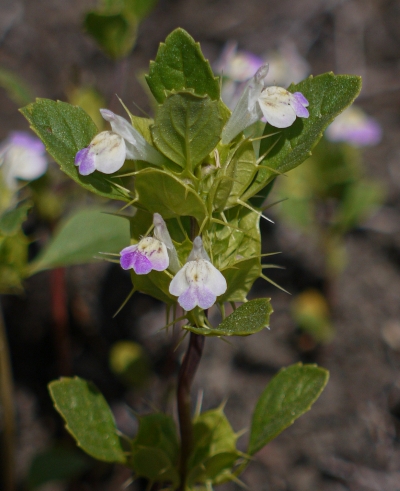 Acanthomintha duttonii by Ken Hickman (Public Domain)
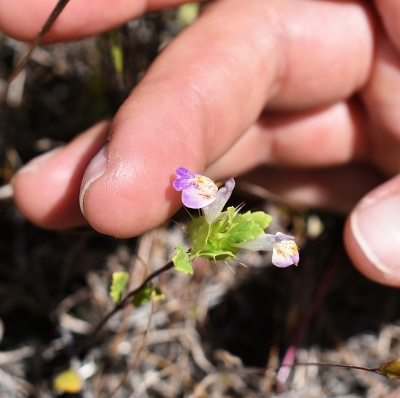 Acanthomintha duttonii by Raffica La Rosa (CDFW)
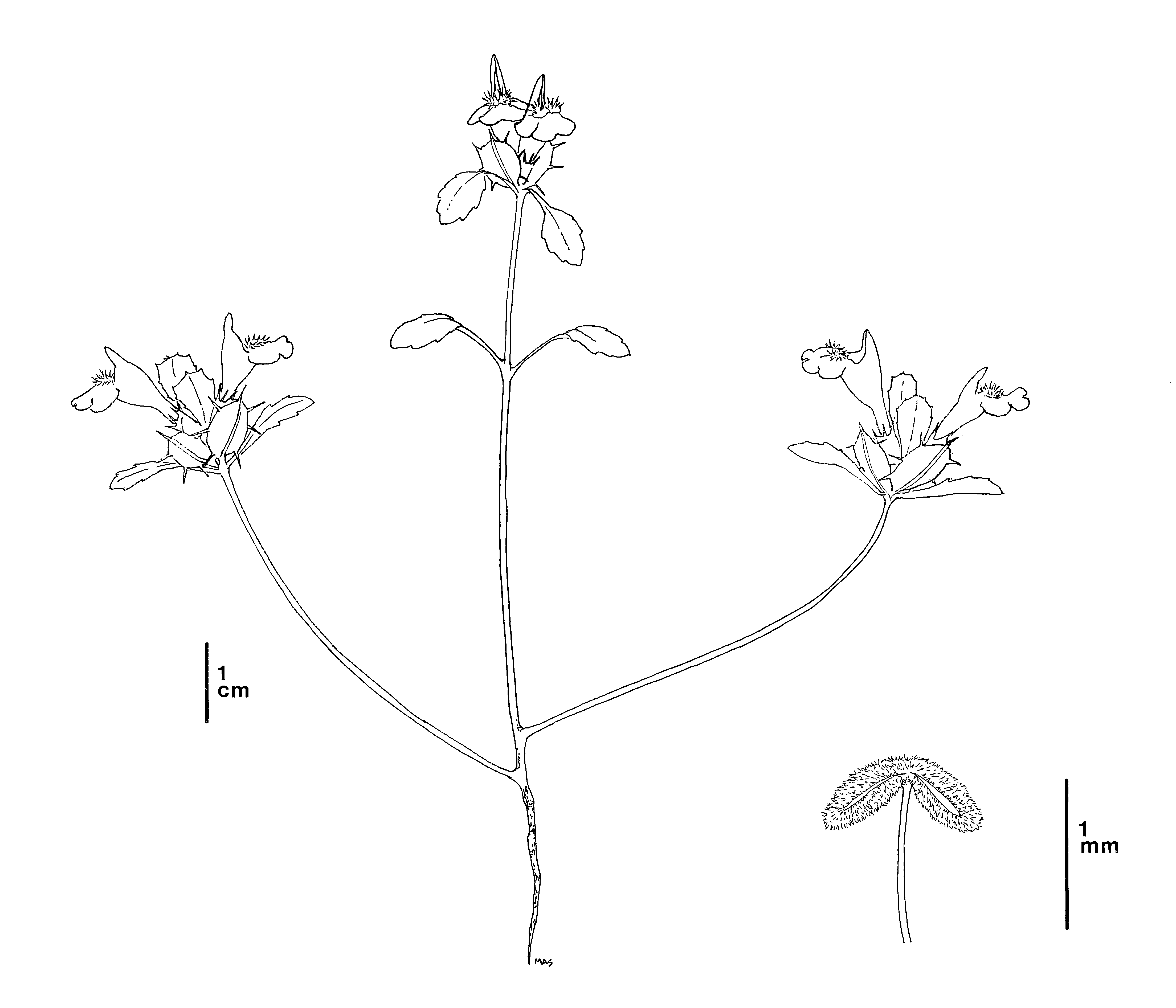 Acanthomintha duttonii. CDFW illustration by Mary Ann Showers. (Click to enlarge)
San Mateo thornmint (Acanthomintha duttonii) is a California threatened plant species, and killing or possessing the plant is prohibited by the California Endangered Species Act (CESA). This species is also listed as endangered under the federal Endangered Species Act (ESA).
San Mateo thornmint is a small, aromatic annual herb in the mint family (Lamiaceae). Individual plants are unbranched and stand no more than 20 cm (7.9 in) off the ground. The white flowers can be tinted with lavender and occur in tight clusters. They generally bloom from April to June, and the plant is typically self-pollinating. San Mateo thornmint is distinct from other closely related thornmint species by its pink-red anthers and lack of needlelike spines on the upper leaves.
Distribution
San Mateo thornmint has uncommon habitat requirements, only occurring in the Bay Area on serpentine soils with heavy clay content. Two historical populations of the species were extirpated due to development. The one remaining known natural population at San Mateo County's Edgewood Park and Natural Preserve is surrounded by unsuitable habitat or urban development, with housing just upslope of the population.
In 2008, the abundance of San Mateo thornmint was at a low. It was only known from the one remaining population, where it occupied just 0.05 acres (smaller than a tennis court). Since then, the species has been reintroduced to several areas, including elsewhere at Edgewood Park beginning in 2009, and on Ring Mountain Preserve in Marin County in 2025. The introduced populations are not yet self-sustaining, but the number of plants has increased from about 200 in 2008 to more than 20,000 in 2025.
Conservation
Although work has been done to enhance San Mateo thornmint habitat and promote population expansion, further action is necessary to aid in the preservation of the species. The threat of random natural events like fire, drought, and hillside erosion, as well as human-related destruction, pose a real risk to San Mateo thornmint because of the species' small and fluctuating population size and extremely limited range. Management of invasive non-native grasses and native parasitic dodder (Cuscuta californica) is also essential for maintaining existing populations. Habitat management and further reintroduction of the species into suitable habitat will help maintain the species. San Mateo thornmint seeds are preserved in long-term storage at the National Seed Storage Laboratory in Fort Collins, Colorado and at the UC Berkeley Botanical Garden in Berkeley, California.
CDFW may issue permits for San Mateo thornmint pursuant to CESA, and we invite you to learn more about the California laws protecting San Mateo thornmint and other California native plants. Populations of San Mateo thornmint occur in CDFW's Bay Delta Region.
References
- California Department of Fish and Wildlife. (2025). California Natural Diversity Database.
- McCarten, N. F. 1986. A study of the ecological aspects related to the reintroduction of Acanthomintha obovate ssp. duttoni (PDF). Prepared for the Endangered Plant Program, California Department of Fish and Game.
- Miller, J. M. and J. D. Jokerst. 2012. Acanthomintha duttonii, in Jepson Flora Project (eds.) Jepson eFlora . Accessed on January 13, 2026.
- Niederer, C., Kent, M., and S. B. Weiss. 2025. San Mateo thornmint (Acanthomintha duttonii) restoration project and Ring Mountain feasibility study. Status Report, Prepared for California Department of Fish and Wildlife, Research Permit No. 2081(a)-20-020-RP.
-
Pavlik, B. M. and E. K. Espeland. Creating new populations of Acanthomintha duttonii. Prepared for the Endangered Plant Program, California Department of Fish and Game.
- Steeck, D. M. (1995). Reproductive biology of a rare California annual, Acanthomintha duttonii, and its congener, Acanthomintha obovata ssp. cordata. M.A. thesis, University of California, Davis.
- U.S. Fish and Wildlife Service (USFWS). 1998. Recovery plan for serpentine soil species of the San Francisco Bay Area (PDF) . Portland, OR.
- U.S. Fish and Wildlife Service (USFWS). 2019. Recovery plan amendment for recovery plan for serpentine soil species of the San Francisco Bay Area (PDF). Sacramento, CA.
Updated 04/23/2026