CNDDB logo

Subscribe

Sign up to receive new posts by email.

    Search

    CNDDB News Blog

    All CNDDB Blog Posts

    rss

    View of snowy mountain and alpine meadow near Carson Pass, California
    Photo credit: Rachel Powell 

    May 22nd is the link opens in new windowInternational Day for Biological Diversity, and the theme this year is “Our Solutions are in Nature.”

    The California Floristic Province is one of link opens in new window36 biodiversity hotspots in the world, due to its unique climate and geologic history, high numbers of native and endemic species, and severe loss of natural vegetation. There are link opens in new windowover 5500 plant species native to California, and 40% of these are endemic—they are found nowhere else in the world. California is also home to almost 40 million people, and some of the most densely populated regions of the state are also centers of high biodiversity.

    Biological diversity contributes to many important ecosystem services, such as pollination, water filtration, carbon sequestration, and recreation. Diverse ecosystems are also more resilient and will likely play important roles in our efforts to mitigate and adapt to a changing climate.

    Here at the California Natural Diversity Database, we strive to provide the best available data on rare and sensitive species in order to help preserve California’s rich biodiversity. To learn more about the California Biodiversity Initiative and other ways that the department is working to promote biodiversity, visit the CDFW Biodiversity web page.

    Categories:   Education and Awareness

    California condor in flight. The California condor is a federally and state listed endangered species.

    May 15th marks the 15th annual Endangered Species Day. Today is all about learning the importance of protecting endangered species and everyday actions that can be taken to help protect them. With nearly 300 federally listed endangered and threatened plants and animals in the state, California is a hot spot for rare species, second only to Hawaii in the number of federally listed species.

    While many species still hover on the brink of extinction, it is important to celebrate the victories that have occurred, and that would not have been possible without the Endangered Species Act. Perhaps the most iconic endangered species in California is the California condor. In the late 1980s, fewer than 30 birds were left in the world and a captive breeding was implemented. Today there are over 450 condors thanks in large part to the research and resources that were devoted to helping this species recover once it was placed on the Endangered Species List. Keeping species from becoming extinct is what the Endangered Species List is all about. The California condor is just one example of what can be achieved once a species becomes classified as an endangered species. Endangered Species Day is a great way to acknowledge the successes in preventing extinctions that have occurred due to the Endangered Species Act and to remember that there are hundreds of species in California that need our help to survive.

    For additional information on Endangered Species Day and actions you can take to help protect endangered and threatened species, please see the link opens in new windowEndangered Species Coalition website.

    Categories:   Education and Awareness

    Sir David Attenborough sitting by the Great Barrier Reef, circa 2015
    Sir David Attenborough sitting by the Great Barrier Reef. 
    Courtesy of link opens in new windowDepartment of Foreign Affairs and Trade website
    (link opens in new windowCC BY 3.0 AU) link opens in new windowvia Wikimedia Commons

    94 years ago today, one of the most inspiring natural history figures was born. Sir David Attenborough was born in Middlesex, England on May 8th, 1926. During his childhood, he collected fossils and natural specimens that were admired by his young peers. The passion and curiosity David discovered for the natural world would propel an impressive and inspiring broadcasting career. After earning a degree in natural sciences from Clare College in Cambridge in 1945, David went on to serve in the Royal Navy where he was stationed in North Wales for two years. An extensive filmography and list of published books ranging from the early 1950s to 2019 has earned David many accolades, including 32 honorary degrees, the 2005 Nierenberg Prize for Science in the Public Interest, the 2015 Individual Peabody Award, and several Primetime Emmy awards. In addition to these, he has had over 20 plant and animal species names after him including Attenborough’s Pintail (Acisoma attenboroughi), alpine hawkweed (Hieracium attenboroughianum), and a species of echidna (Zaglossus attenboroughi). He may be most known for his narration and presenting for 1979’s Life on Earth, Planet Earth, and The Blue Planet natural documentary series. David’s soothing voice has been capturing the curiosity of people around the world for decades and has given us an amazing look inside the natural world we would otherwise not know without him. These documentaries have inspired many of us to make a living of preserving these amazing species as well as the lands they call home. It is no wonder that Sir David Attenborough is known as a UK national treasure as well as a world treasure. So, Happy Birthday to this incredibly influential, respected, and endearing natural historian! We leave you inspired as Sir David often does with this powerful quote from the man himself, “It seems to me that the natural world is the greatest source of excitement; the greatest source of visual beauty; the greatest source of intellectual interest. It is the greatest source of so much life that makes life worth living.”

    Categories:   Education and Awareness

    The quarterly update of the Barred Owl Observations Database is available in the BIOS Viewer for CNDDB subscribers. The barred owl database includes barred owl (Strix varia), Strix hybrid, and unknown Strix detections.

    Many of the records represent incidental detections made during spotted owl surveys; therefore, this dataset may not accurately represent the current distribution of barred owls in California. Furthermore, this dataset is only available to CNDDB subscribers because it contains references to sensitive spotted owl locations. A public version will be available in the future.

    For a copy of the geodatabase or for site-specific inquiries, contact the database manager at owlobs@wildlife.ca.gov

    Screenshot of BIOS mapping application displaying the barred owl dataset

    Categories:   Quarterly Updates

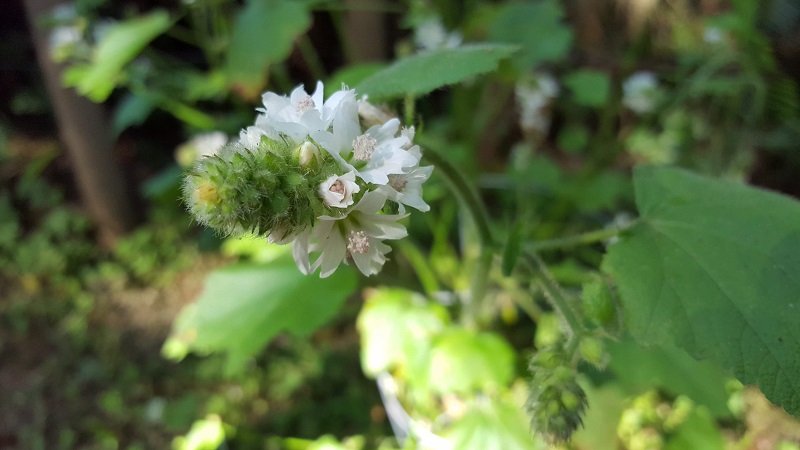
    Closeup of the flower clusters of maple-leaved checkerbloom

    Sidalcea malachroides – maple-leaved checkerbloom

    Submitted by Valeri Sinco

    This little beauty was found by Valeri Sinco in Humboldt County. Sidalcea malachroides was originally listed in 1994 as a rank 1B (rare or endangered in California and elsewhere) and was more recently changed to a rank 4.2 (limited distribution in California; fairly endangered in California) in the California Rare Plant Ranking system. It is found in a multitude of habitats along the coast including broad-leafed upland forest, North Coast coniferous forest, riparian woodland, coastal prairies and coastal scrub. Sidalcea malachroides ranges from the Central Coast in California north along Oregon’s coast where it is also of conservation concern. It blooms from April to August, but early blooms have been found in March. Thank you, Valeri, for everything you do to help protect these plants and for sharing this beautiful photo!
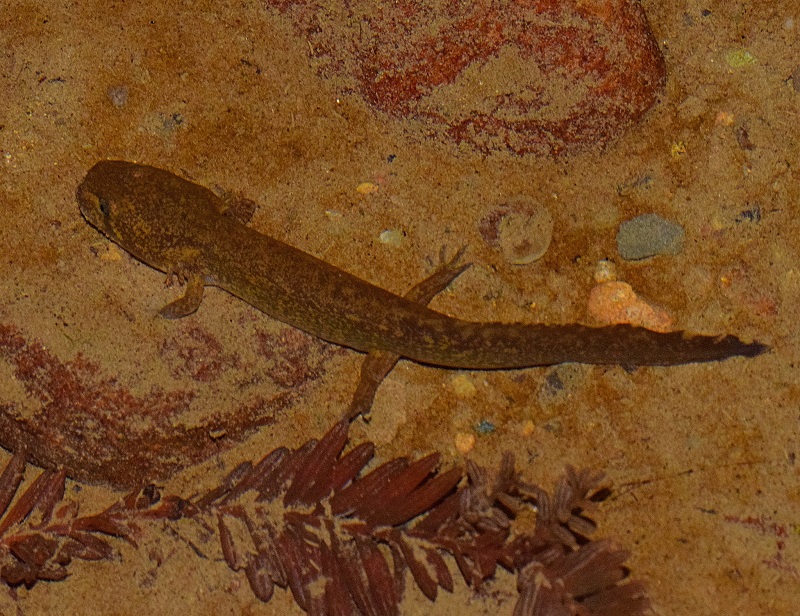
    A top-down view of a California giant salamander larvae under water

    Dicamptodon ensatus – California giant salamander

    Submitted by Daniel Palmer & Tommy Kelley of the California Department of Transportation

    This larval stage California giant salamander was staying nice and still for Daniel and Tommy. They found it near Fort Ross in Sonoma county. When this salamander is fully grown, it will display reddish-brown colored marbling. The California giant salamander lives up to its name being one of the largest salamander species in North America and are endemic to California. Its flat tail is designed perfectly for swimming which helps its short, stout limbs in the water. You can find this salamander in damp, coastal forests throughout Sonoma and surrounding counties as well as San Mateo and Santa Cruz counties. These critters eat anything they can overpower, including slugs and small invertebrates like birds and lizards! Its current distribution has not changed much from its historic distribution, but their native habitats have seen a lot of alterations. Currently, the database has 234 mapped occurrences throughout its range. Many thanks to Daniel and Tommy for snapping a picture of this species!

    Do you have some great photos of rare plants or wildlife detections? Submit them along with your findings through our Online Field Survey Form and see if your photos get showcased!

    Categories:   Contributor Spotlight

    Biogeographic Data Branch
    Physical Address: 1700 9th Street, 4th Floor, Sacramento, CA 95811
    Mailing Address: P.O. Box 944209, Sacramento, CA 94244-2090
    (916) 322-2493 | BDB@wildlife.ca.gov