by Brian Acord
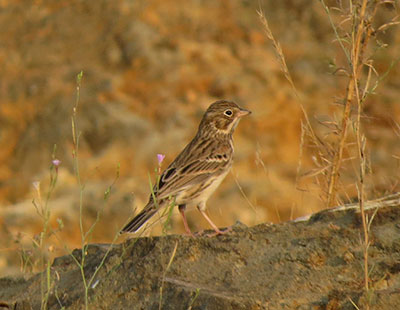 Vesper sparrow, likely affinis, photographed by Chris Conard at Folsom Point, Folsom Lake, Sacramento County, 9/2014
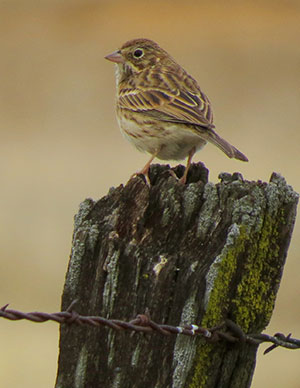 Vesper sparrow, likely affinis, photographed by Chris Conard along Meiss Road, Sacramento County, 11/2014
The days are getting shorter and the temperatures are gradually decreasing. Most biologists are wrapping up their field seasons and getting ready to compile their data and draft their reports. I’m sure some folks welcome the change of season and the change of pace, yet others long for the pursuit of discovering that rare species. Whereas most species tracked by CNDDB are targeted during the spring and summer months, there are some feathered friends who make California their winter retreat. One such species is the Oregon vesper sparrow (Pooecetes gramineus affinis): a California Bird Species of Special Concern (BSSC) and a Species of Greatest Conservation Need (SGCN) in the current State Wildlife Action Plan (SWAP). These rankings may offer potential opportunities for funding under the State Wildlife Grant (SWG) program for research and monitoring.
Vesper sparrows are a medium to large sparrow with a complete white eye-ring, white outer tail feathers, and a rufous shoulder patch (lesser wing coverts). Its scientific name should be familiar to botanists, taken directly from its habit: Pooecetes is Latin from the Greek poa, oiketes, meaning grass dweller and gramineus is Latin referring to grass (Terres 1995). Vesper sparrows are often found skulking around, foraging for invertebrates and seeds in open lowland areas with short grass, or stubble fields with sparse shrubs for retreat.
One of the challenges of monitoring Oregon vesper sparrows is differentiating them from all the other “little brown jobs” overwintering in California, and especially from the other vesper sparrow subspecies, the Great Basin vesper sparrow (P. g. confinis). The Oregon vesper sparrow breeds primarily in Washington and Oregon west of the Cascade Mountains, and winters in the Central Valley. The Great Basin vesper sparrow breeds in California on the east side of the Sierra Nevada Mountains, but also winters in the Central Valley as well as portions of southern California. Yes, it’s probably close to impossible to reliably separate these two subspecies by sight alone. This is acknowledged in the Bird Species of Special Concern research recommendations, which identified the need to better define the wintering range of the affinis subspecies. It’s possible this might be achieved by combining standardized winter grassland surveys with a method such as banding that allows for subspecies differentiation. According to Pyle (1997), affinis is generally smaller than confinis and can be separated morphometrically. In order to ensure appropriate winter habitat is preserved, it first must be accurately identified though systematic surveys. This, combined with mark and recapture studies, may help identify the degree of site fidelity on both the wintering and breeding grounds, and pave the way for further physiological, behavioral, and genetic studies.
Comparison of wing and tail size (mm) between the smaller P. g. affinis and larger P. g. confinis (Pyle 1997)
| Subspecies |
Wing |
Tail |
| P. g. affinis, Oregon - Male |
73-81 |
52-62 |
| P. g. affinis, Oregon - Female |
71-77 |
51-59 |
| P. g. confinis, Great Basin - Male |
78-87 |
62-70 |
| P. g. confinis, Great Basin - Female |
75-84 |
58-67 |
The Oregon vesper sparrow has been listed as Endangered in Canada since 2006 ( COSEWIC 2006). Despite targeted surveys, no breeding attempts have been confirmed in Canada since 2014 (COSEWIC 2018). The subspecies is in danger of being extirpated from Washington due to habitat loss and degradation (WDFW 2015). In Oregon, the Oregon vesper sparrow is classified as “Sensitive – Critical” meaning that if immediate conservation actions are not taken, listing as Threatened or Endangered would be appropriate (ODFW 2016). In the late 1970s a breeding population of the Oregon vesper sparrow was discovered in the far northern coastal dune system in Del Norte County, California (Erickson 2008). However, no vesper sparrows were found in this area during surveys conducted in 2016 (American Bird Conservancy 2017).
Recently the U.S. Fish and Wildlife Service was petitioned to list the Oregon vesper sparrow as Threatened or Endangered (American Bird Conservancy 2017). The Service agreed that the petitioned action may be warranted citing the following threats: habitat loss primarily from development, conversion to agriculture and vineyards, and grazing; habitat degradation from invasive shrubs; and establishment of non-native grasses replacing short-statured grasses and forbs (USFWS 2018a, USFWS 2018b).
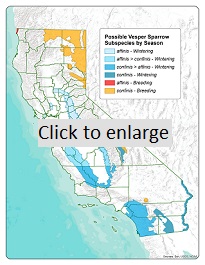 Map of possible vesper sparrow distribution by species
One might wonder, what does all of this have to do with California? While the core breeding areas of the Oregon vesper sparrow include the western portions of Washington and Oregon, it is thought to overwinter almost entirely in California (AOU 1957 [the last AOU list to include subspecies], King 1968, Erickson 2008 (PDF)). For this unique subspecies to persist it needs safe and appropriate overwintering habitat in addition to its northern breeding grounds. Within California, its overwintering areas are subject to the same threats as its breeding grounds: loss of relatively open, flat ground at low elevations due to development and conversion to agriculture (Erickson 2008 (PDF)).
In short, if you’re seeking a challenging winter project, look no further than the Oregon vesper sparrow in California. The California Department of Fish and Wildlife and the U.S. Fish and Wildlife Service are interested in your sightings of overwintering Oregon vesper sparrows, and the best way to document your detections is through the CNDDB Online Field Survey web application.
References and Resources
- American Bird Conservancy. 2017. Petition to list Oregon vesper sparrow (Pooecetes gramineus affinis) as endangered or threatened under the U.S. Endangered Species Act (PDF)
- American Ornithologist Union. 1957. Check-list of North American birds. 5th edition
- California Department of Fish and Wildlife (CDFW). 2015. State Wildlife Action Plan
- California Department of Fish and Wildlife (CDFW). State Wildlife Grants
- California Wildlife Habitat Relationships (CWHR). Life history account for Vesper Sparrow, Pooecetes gramineus (PDF)
- California Wildlife Habitat Relationships (CWHR). Range map for Vesper Sparrow, Pooecetes gramineus (PDF)
- Cornell Lab of Ornithology. All About Birds: Vesper Sparrow
- COSEWIC. 2006. COSEWIC assessment and status report on the Vesper Sparrow affinis subspecies Pooecetes gramineus affinis in Canada
- COSEWIC. 2018. COSEWIC assessment and status report on the Coastal Vesper Sparrow Pooecetes gramineus affinis in Canada (PDF)
- eBird. Vesper Sparrow
- Erickson, R. 2008. Oregon Vesper Sparrow (Pooecetes gramineus affinis)
- Grinnell, J. and A. Miller. 1944. The Distribution of the Birds of California
- Jones, S. and J. Cornely. 2002. Vesper Sparrow (Pooecetes gramineus)
- King, J. 1968. Pooecetes gramineus affinis Miller, Oregon vesper sparrow
- National Audubon Society. Guide to North American Birds: Vesper Sparrow (Pooecetes gramineus)
- Oregon Department of Fish and Wildlife (ODFW). 2016. Sensitive Species List
- Pyle, P. 1997. Identification guide to North American birds: part 1. Slate Creek Press, Bolinas, CA. 732 pages.
- Terres, J. 1995. The Audubon Society Encyclopedia of North American Birds. Alfred A. Knoph, New York. 1,109 pages.
- United States Fish and Wildlife Service (USFWS). 2018a. Endangered and threatened wildlife and plants; 90-day findings for three species
- United States Fish and Wildlife Service (USFWS). 2018b. 90-day finding on a petition to list Oregon vesper sparrow (Pooecetes gramineus affins) as Threatened or Endangered under the U.S. Endangered Species Act
- United States Fish and Wildlife Service (USFWS). Environmental Conservation Online System species profile for Oregon vesper sparrow (Pooecetes gramineus ssp. affinis)
- Washington Department of Fish and Wildlife (WDFW). 2015. Washington’s State Wildlife Action Plan: 2015 update
Photo credit: Chris Conard is a Natural Resource Specialist for the County of Sacramento, Coordinator & compiler for the Folsom Christmas Bird Count, Board member of the Central Valley Bird Club, eBird Regional Reviewer and Hotspot Editor for Sacramento County, and influential member of Sacramento Audubon Society.