Visit a California river in January and again in August, and you’ll see two different places. Winter storms send water surging over the banks, while late summer brings a slow trickle between gravel bars. This transition is the natural rhythm that keeps California’s rivers and wildlife healthy. Understanding this natural pattern guides the California Department of Fish and Wildlife’s (CDFW) understanding of rivers today. No two seasons are alike, just like no two water years are alike. As a result, CDFW needs to work with the water nature provides each year, to better understand rivers and work to protect fish. Protecting native fish is critical to maintaining the biodiversity that makes California a unique and special place to live, raise a family, and make a living. Outdoor recreation, fishing, and abundant fresh food produced with reliable agricultural water despite the ups and downs of climate change are cornerstones of California culture and our economy.
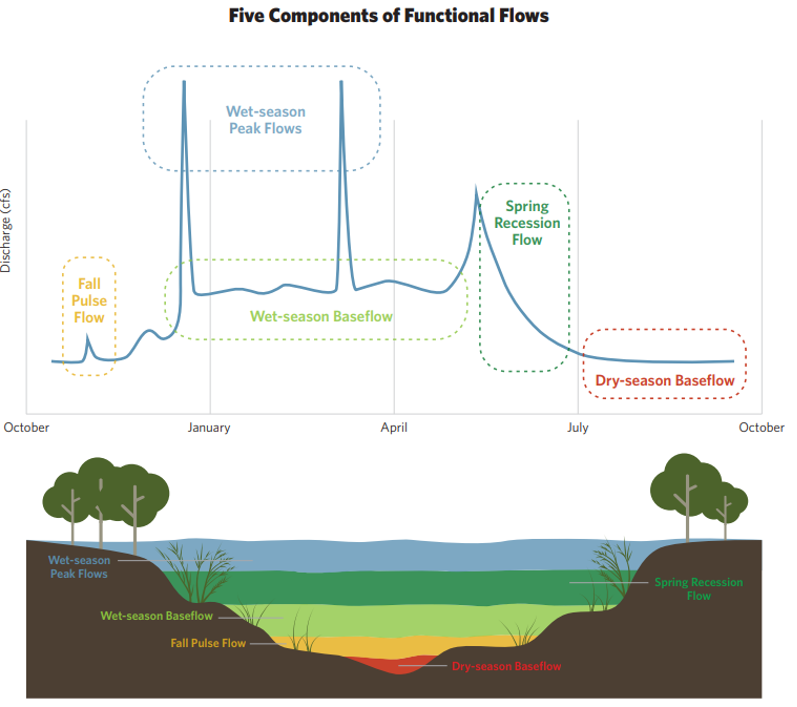
Figure 1. The generalized hydrograph on top shows how flows change throughout the year, highlighting the five functional flow components. The bottom panel shows how each of the flow components produces a different set of conditions in a river channel, changing the aquatic habitat available (CEFF Executive Summary V9)
What Are Functional Flows?
To account for natural variability, CDFW uses functional flows. Functional flows are the key parts of a river's natural yearly flow pattern that do a specific job for the ecosystem. Instead of asking only, “how much water does a river need?”, the approach also asks, “when, how fast, and for how long?”
Scientists have found that California's rivers and streams follow five main flow patterns, each linked to a different part of the year. The water year begins in fall with the fall pulse flow, a short burst of water that flushes out the stream and signals fish to migrate. This is followed by winter storms which bring peak flows, moving gravel and sediment, reshaping the channel, and moving water onto floodplains. Between storms, steady wet-season baseflows keep the habitat connected, allowing fish to move, feed, and grow. In spring, as snowmelt and rains taper off, the spring recession flow brings water levels down gradually. This recession cues spawning and migration for some species, while simultaneously helping young fish and plants get established. Finally, the low dry-season baseflow of summer and early fall sustains pools and cool-water refuges until the rains return and the cycle starts again. Each river has its own version of this pattern. So, while each river type follows this five-part pattern, the details of how and timing when the flows happen make each one unique.
How Functional Flows Support Ecosystem Health
A healthy river is more than just water flowing through a channel. It's a connected system of fish, insects, vegetation, wetlands, and people who depend on them. Each functional flow supports a different piece of that system.
|
Functional flow
|
What it does
|
Who benefits
|
|
Fall pulse
|
Flushes fine sediment and cues fish to migrate upstream
|
Adult salmon and steelhead returning to spawn
|
|
Peak flows
|
Moves gravel, builds side channels, and floods floodplains
|
Spawning fish, young fish that feed on floodplains, cottonwoods and willows
|
|
Wet-season baseflow
|
Keeps streams connected to the floodplain and side channel habitat through the winter
|
Migrating and rearing fish
|
|
Spring recession
|
Gradual drop cues spawning and lets seedlings root
|
Native fish, frogs, and streamside plants
|
|
Dry-season baseflow
|
Maintains pools and cool water through summer
|
Fish, frogs, and wildlife that need year-round water
|
When any of these flow components are missing or degraded, the whole system can suffer. Salmon may not get the cue to migrate, gravel beds can clog with silt, and young trees may not survive. That's why CDFW focuses on functional flows. Restoring the right flows, at the right times, supports the entire river ecosystem, not just a single species.
The Spring Recession
The spring recession is one of the five functional flows that is both important and easily lost. In a natural river, spring flows don't shut off overnight; they ease down over weeks as snowpack melts and storms become less frequent. That slow decline does a lot of work. Falling flows and warming water signal native fish it’s time to spawn and helps push young salmon downstream toward the Sacramento-San Joaquin Delta, San Francisco Bay, and out to the ocean. The water that reaches the Bay-Delta creates productive rearing habitat for native fish, moving food resources to the habitat where fish gather. On land, the recession matters too. Seedlings take root along the receding water line, but if flows drop too fast, they can dry out before their roots can reach groundwater. When reservoirs capture spring runoff or flows are stopped abruptly, that gradual signal disappears. Protecting the shape of the spring recession, not just the total volume of water, is key to CDFW's work.
Working With What Mother Nature Gives Us
We ask a lot of California’s rivers: they sustain fish and wildlife; provide drinking water; offer places to fish, paddle, and play; form the foundation of our commercial fisheries; and serve as part of complicated delivery systems that move water across the state to support communities, farms and industry. We ask all of this while California's water supply changes from year to year, with climate change making predicting those swings more challenging. To try and manage all those priorities, water managers in the Central Valley classify each year by type, from critically dry to wet, based on rain, snowfall, and conditions in the year before. A river in a wet year might carry several times the water it carries in a dry year at the same spot and season. Functional flows adapt to this variability, making them a natural fit for a changing climate. Rather than setting one fixed number for every year, the approach starts with a simple question: how much water did nature provide this year? Flow goals then scale up or down with what the year delivers. In wetter years, there’s more water to go around. This approach ensures big winter and spring flows reach the places fish and wildlife need them most, such as floodplains and the Bay, while still meeting other needs. In dry years, the focus shifts to protecting the most critical flows, like the summer baseflows that keep fish alive until the rain returns. Climate change brings hotter temperatures, smaller snowpacks, and bigger swings between drought and flood. Managing functional flows lets CDFW respond to each year as it comes, maximizing wet years and protecting what matters most for fish and wildlife in dry ones.
Science in Action at CDFW
CDFW is known for its regulatory work, but the Department is also a science agency. Its scientists study California's ecosystems, and that research informs the decisions CDFW makes. Functional flows demonstrate how science and regulation work together.
The approach grew out of a statewide effort to establish a consistent, science-based approach for setting flow needs for California’s rivers. In 2016, scientists from universities, nonprofits and state agencies, funded by the State Water Resources Control Board, collaborated to develop the California Environmental Flows Framework (CEFF). CEFF uses the functional flows approach and provides tools, including statewide estimates of natural flows, applicable to nearly any stream in California.
Today, CDFW applies functional flows across its programs. The Department's Instream Flow Program uses CEFF tools to create Watershed Criteria Reports, which describe the flows needed to support fish and wildlife across entire watersheds. This work also supports the California Salmon Strategy, the state's plan to protect salmon in a hotter, drier future. Under the strategy, CDFW is completing flow studies for priority streams, coordinating with the State Water Board on environmental flows. The Salmon Strategy also highlights the value of voluntary collaborative solutions to improve instream flow conditions in salmon strongholds.
Partners in Management
No single agency can manage California's water alone with the intent of benefitting people, the economy, fish, and wildlife. Functional flows work is coordinated through the California Environmental Flows Workgroup, part of the California Water Quality Monitoring Council. This group brings together agencies, researchers, and nonprofits to share data and further their efforts on Functional Flows. CDFW partners with the State Water Resources Control Board and the California Department of Water Resources. CDFW also works with researchers at UC Davis and UC Berkeley, as well as organizations like the Southern California Coastal Water Research Project and the Nature Conservancy. Together, these partners have built shared tools, such as the California Natural Flows Database and the Functional Flows Calculator, that anyone can use to explore how a stream naturally flows and how much that pattern has changed.
California's rivers continue to change as the climate does. CDFW's science, carried out alongside its regulatory work, is helping the department meet that challenge. By following the patterns rivers evolved with, and responding to the water each year brings, CDFW and its partners are working to keep river ecosystems healthy for fish, wildlife, and the people who depend on them.